Main content

  1. Small and medium-sized enterprises' (SME) Barometer 2/2024
  2. Number of businesses in the Trade Register by company type
  3. Business shares in different industries of the Finnish economy
  4. The data on opened and closed companies in Finland
  5. Dynamics: Growth in the number of companies 2018—2023
  6. Companies' structure in Finland

Small and medium-sized enterprises in Finland. Statistic data

Number of businesses in the Trade Register, 10.01.2025

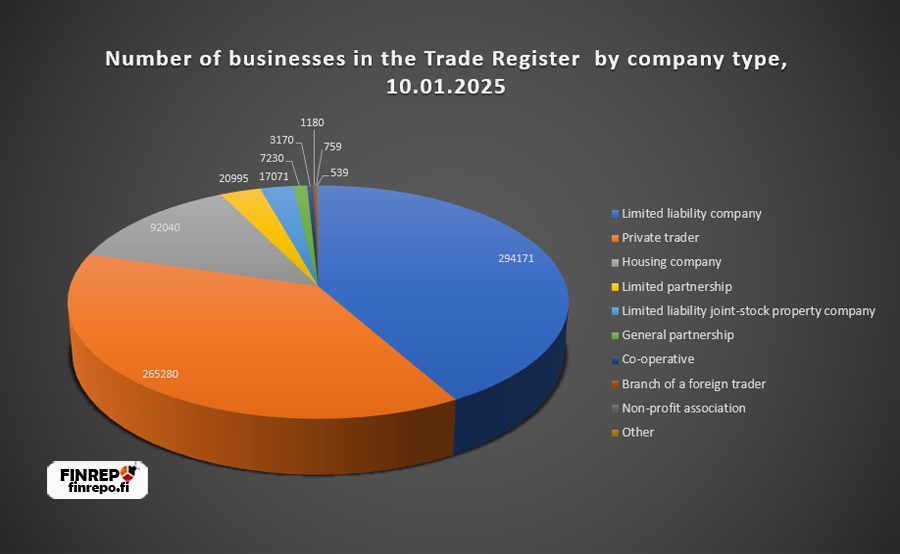
Number of businesses in the Trade Register by company type, Finland 2025

The most popular form of company type in Finland are Limited liability company (42% or 294171 companies). Comparative analysis of the number of businesses by company type for January 2025 - 2021 can be found at the Finnish Trade Register.

Opened and closed companies, 2nd quarter 2025

Enterprise openings in Finland, 2025

According to the Statistics Finland, 12 380 new companies have started their business in the 2nd quarter of 2025 (from April to June) and 10 794 companies have closed their business. See another slide "Enterprise closures in Finland". The number of enterprise closures increased by about 18.1% from 2024 Q2 (9 140) to 2025 Q2.

Dynamics: Growth in the number of companies 2018—2023

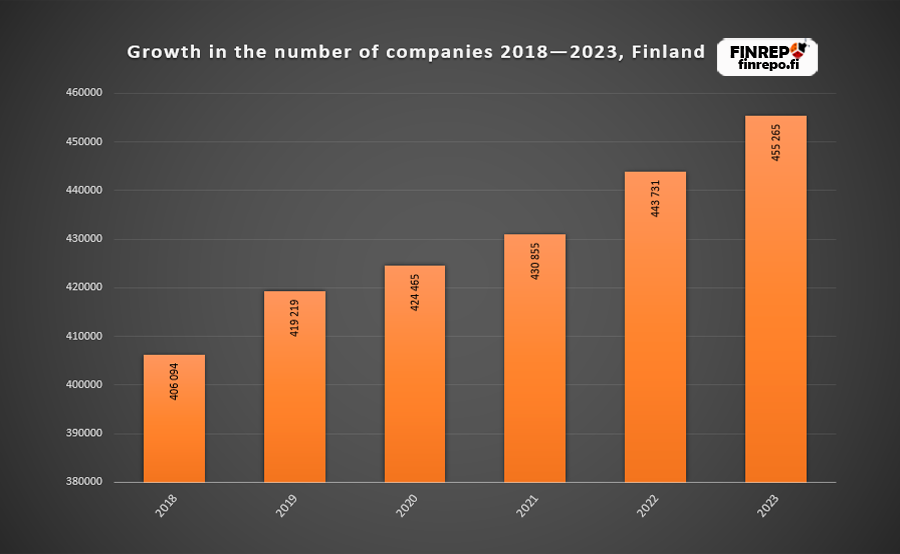
Growth in the number of companies 2018—2023, Finland

According to the Statistics of Finland there were 455 265 companies in 2023 (excluding agriculture, forestry and fisheries). They employ 1.46 million people and generate tax revenue that funds public services. Of all companies, 95.7% have fewer than 10 employees, and small and medium-sized enterprises (SMEs) account for over half (54.1%) of the total €541 billion turnover. Yrittajat.fi and Statistics Finland’s free-of-charge statistical databases.

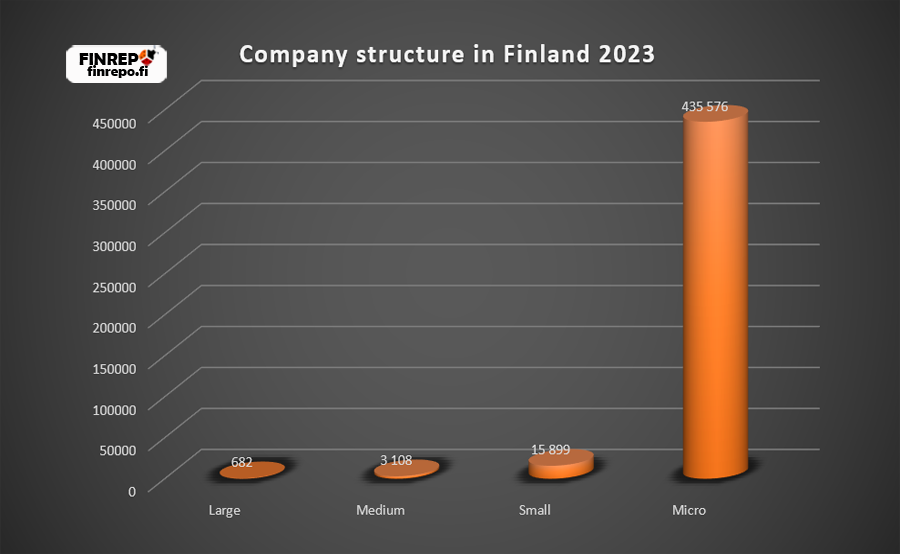
Companies' structure in Finland, 2023

Companys' structure in Finland

According to the Statistics of Finland, 2023, the largest share of companies (95,7) belongs to micro-enterprises. A total of 455 265 companies, excluding agriculture, forestry and fisheries, of which:

  • 0.1% Large companies (≥250 people) 682
  • 0.7% Medium sized companies (50-249 persons) 3 108
  • 3.5% Small businesses (10-49 people) 15 899
  • and 95,7% Micro enterprises (1-9 people) 435 576

There were 185 000 solo entrepreneurs in 2023.

Small and medium-sized enterprises' (SME) Barometer 2/2024

Finnish Entrepreneurs (Suomen Yrittäjät), Finnvera, and the Ministry of Employment and the Economy conduct the SME Barometer twice a year, which outlines the activities and economic environment of small and medium-sized enterprises. The Autumn 2024 SME Barometer is based on 4,155 responses from SMEs. The Barometer offers a comprehensive overview of Finnish SMEs' perceptions of changes in the economic environment and the factors influencing their business and development prospects. The Barometer is published in both national and regional reports. The national report presents the data from the perspective of the entire SME sector, as well as by the main sectors: industry, construction, trade, and services. The regional reports compare the development of companies in the area, surrounding areas, and the country as a whole.

SUMMARY (Updated 17.01.2025)

  • Following a negative start to the year, the economic expectations of SMEs have improved significantly. Low inflation, falling interest rates, and the successful disengagement from Russian energy and trade have turned the strongly negative expectations from spring into an upward trend. The state of the economy is expected to remain stable over the next year 2025.
  • 24% of SMEs expect the economic situation to improve over the next 12 months, and an equal share believe it will deteriorate. Slightly more than half of SMEs expect the situation to remain the same. The direction of the economy depends largely on, among other factors, the recovery of private consumption and the decline in interest rates, the development of which will be closely monitored in all of the key market areas over the next 12 months.
  • SMEs' business cycle expectations predict a development for the Finnish economy that is broadly in line with most economic forecasts. Estimates of economic development based on gross domestic product predict zero growth for Finland on average for the rest of 2024, and during 2025, gross domestic product is most commonly estimated to grow by 1–2 percent. There is still exceptionally significant uncertainty surrounding both the state of the economy and the expectations of SMEs.
  • Expectations for turnover development have strengthened at the same time that general economic expectations have risen from the spring figures.
  • In recent years, SMEs' expectations regarding profitability have weakened significantly, while general confidence in the economy has decreased. Profitability expectations have still not returned to positive levels following the decline that lasted from autumn 2021 to spring 2023.
  • Slightly more SMEs than before expect their solvency to improve. Expectations for solvency development are at the same level as they were a year ago, in autumn 2023.
  • SMEs estimate that they will significantly reduce their investments in the near future. As a result of prolonged uncertainty and a weak economy, more companies are planning to reduce their investments across all major industries than those that will increase investments. The prolonged weak development of investment expectations is linked to exceptionally high uncertainty regarding the recovery of demand, increased geopolitical risks, and other factors related to the operating environment, such as the availability of a skilled workforce. Changes in interest rates also have a direct impact on the investments and investment intentions of SMEs.
  • The negative effects of higher interest rates and increased geopolitical instability have weakened expectations about the development of the number of employees in recent years. Fourteen percent of SMEs plan to increase their workforce in the coming year, while 11 percent of companies expect their personnel numbers to decrease. Nevertheless, the vast majority—74 percent—of SMEs still intend to maintain their current headcount.
  • The expectations of an increase in production costs have risen slightly compared to spring 2024. The price-setting margins of SMEs on their own products and services are also increasing, but not enough to compensate for the rise in prices of intermediate goods.
  • In all main industries, the primary challenge remains the faster price increase of intermediate goods compared to final products. If the growth in intermediate goods prices continues to exceed the increase in pricing margins, it will weaken the operating conditions for businesses.
  • In recent years, many crises have not significantly stifled companies' growth ambitions. More than one-third of SMEs are still, when possible, growth-oriented, and the share of strongly growth-oriented SMEs increased by two percentage points compared to the spring survey, in which the share was five percent. The proportion of strongly growth-oriented SMEs remains modest, and the long-term downward trend raises concerns.
  • 16% of small and medium-sized businesses have adopted new technologies, and 46% have invested in digitalization over the past year. About half of the companies have also trained their staff. Additionally, just under 30% have launched new products or services.
  • In this barometer, research and development (R&D) refers to creative and systematic activities aimed at increasing knowledge and applying it to new solutions. A high proportion of SMEs, 25%, report engaging in some form of R&D. There are significant sectoral differences, with the highest share in industry, where 40% of SMEs are involved in R&D activities.
  • The economic situation and weakened creditworthiness of businesses, combined with banking regulation, are reflected in SMEs' access to external financing. According to the barometer, fewer than half of SMEs have loans from banks or other financial institutions. The proportion of SMEs with such loans has remained largely unchanged in recent years.
  • Finnvera remains a key financial player, although its role as an alternative and complement to bank loans has slightly decreased. Business Finland and ELY Centers also continue to be important financing sources for SMEs. Finnvera's guarantees play a crucial role in securing funding: nearly a third of those seeking bank loans reported that financing required Finnvera's guarantee. Growth-oriented companies are particularly interested in Finnvera as a financer.

The Autumn 2023 SME's Barometer is based on 4 573 SMEs' responses.

SUMMARY (Updated 29.10.2023)

  • Following an exceptionally negative beginning of the year, the economic expectations of SMEs have almost returned to close to their slightly negative level from a year ago. The easing of the energy crisis and the leveling off of the effects of the Russia–Ukraine War turned the direction of expectations upward, although they still remained negative. The state of the economy is expected to weaken slightly over the next year. Weak expectations are partially explained by the Russia–Ukraine War, the record-fast rise in interest rates, and the cost level, which has remained high for the second year.
  • 21% of SMEs estimate that economy will improve over the next 12 months, 27% believe it will weaken, and slightly more than half of SMEs estimate it will remain at the same level.
  • Expectations for the development of turnover have strengthened at the same time as general economic expectations have risen from the spring lows.
  • In recent years, expectations regarding profitability have weakened strongly while general confidence in the economy has decreased. However, profitability expectations have improved slightly in all main industries compared to spring 2023.
  • Slightly more SMEs than before expect their solvency to improve. After an exceptional previous year, expectations about the development of solvency have therefore begun to slowly recover.
  • SMEs estimate that they will significantly reduce their investments in the near future. As a result of weakened business cycle and growth expectations, there are more companies that are going to reduce their investments in all main industries than those that will increase investments. The weak development of the investment expectations is related to exceptionally high uncertainty caused by the Russia - Ukraine War, continued inflation and rapid rise in interest rates.
  • The considerable negative effects of the war and the very uncertain future prospects have slightly weakened expectations about the development of the number of personnel. Only 14 % of SMEs plan to increase the employee amount, and 12% of companies expect the number of their personnel to decrease. Nevertheless, the vast majority, 74 %, of SMEs still intend to maintain their current headcount.
  • The expectations of an increase in production costs have decreased slightly from their peak in autumn last year. However, the balance figure for the expectations still remains high. The price-setting margins of SMEs’ on their own products and services has also increased, but the growth rate has slowed down. The increase in price-setting margins cannot compensate for the rise in the prices of intermediate products: production costs are expected to increase almost one-and-a-half times faster than the prices of end products. Somewhat surprisingly, but the situation is alleviated by the moderate pay increase expectations despite the fact that many industries are suffering from labor shortages.
  • Sustainable economic growth, the general employment situation and the profitability development of the national economy depend on the ability and possibilities of the private sector to operate and develop. Unnecessary restrictions to the business opportunities or competition have a negative impact on the growth potential of the national economy and employment. Correspondingly, supporting the companies' growth opportunities is linked to a better employment situation and the easing of public finance challenges.
  • The positive thing is that the long-standing decline in the number of growth-oriented companies has halted, at least for now. The share of SMEs which seek growth intensively has increased by 2 percentage points. However, the share of growth-oriented companies is modest, and the long-term declining trend causes the concern.
  • Digitalisation and robotisation, together with other technological developments, are progressing rapidly, regardless of economic cycles, and are affecting the daily operations of the companies more and more strongly. 15 % of SMEs have introduced new technology over the last year and 43 % have invested in digitalisation. In all industries, slightly more than half of the companies had arranged training for their personnel. In addition, three out of ten companies have introduced new products or services to the market.
  • A relatively high proportion of SMEs, 22 %, report that they are engaged in research and development activities in some form. As expected, there are significant differences between industries in the R&D activity. The largest share is found in industry, where 39 % of SMEs conducting R&D activities.
  • The strict regulation of banking and the weakened creditworthiness of companies are reflected in the use of external financing by SMEs. The proportion of SMEs that have a loan from a bank or other financial institution has changed very little in recent years. Finnvera has remained a significant financial player and its role as an alternative and supplement to bank loans has grown slightly. Finnvera's guarantee plays a key role in obtaining financing: almost a third of those who applied for bank financing said that the availability of financing required Finnvera's guarantee. It is notably that growth-oriented companies in particular are interested in Finnvera’s financing.
  • The COVID 19 pandemic period increased the pressure on the digitalization of the business of SMEs, because face-to-face interaction decreased and an increasingly large part of the daily work of companies took place digitally. Now the speed of implementation of digital services and tools seems to have evened out.
  • Own websites are still clearly the most commonly used digital tool in the business of companies. In addition, SMEs make use of, for example, social media, cloud services and online purchases.
  • Russia-Ukraine War has caused a significant increase in the uncertainty related to economic prospects and financing. The overall impacts extend beyond just those companies that have direct business risks related to Russia. This war affects SMEs in very different ways. Almost half of the companies state that it had a negative impact on the company’s business or production. However, it is clear that there is still great uncertainty regarding the war and its effects, and uncertainty is poison to the economy. It slows down both investments and consumption in Finland. The most important of the uncertainty factors is prolonged inflation and the resulting rapid and strong increase in the interest rates, which has a direct impact on, for example, purchasing power.

The Autumn 2022 SME's Barometer is based on 4 829 SMEs' responses.

SUMMARY (Updated 15.11.2022)

  • At the beginning of the year, the prospects for SMEs had clearly improved after the exceptional pandemic period, and economic expectations had risen strongly. The situation changed when the Russia–Ukraine War began, the acceleration and prolongation of price increases, the decrease in foreign trade and increased uncertainty weakened the prospects for investments and private consumption. The situation is directly reflected to the prospects of small and medium-sized enterprises regarding the economic development in the near term. Expectations have fallen sharply.
  • Expectations for the development of turnover follow general economic expectations to some extent: they have decreased at the same time as general economic expectations have weakened strongly.
  • Expectations regarding profitability have also weakened, but even more so than turnover expectations.
  • Expectations about the solvency development have also weakened clearly compared to the year before.
  • Expectations for revenue growth are low and uncertainty reduces investments. SMEs estimate that they will significantly reduce their investments in the near future. In all main businesses, with the exception of industry, there are more companies that are going to reduce their investments than those that will increase investments. The weak development of investment expectations is related to exceptionally high uncertainty about the continuation of the war and the pandemic, the rise in interest rates and the speed of economic growth.
  • The considerable negative effects of the war and the very uncertain future prospects have slightly weakened expectations about the development of the number of personnel. Only 17 % of SMEs plan to increase the employee amount, and a tenth of the companies expect the number of personnel to decrease. Nevertheless, the vast majority, 73 %, of SMEs still intend to maintain their current headcount.
  • Expectations of an increase in production costs are strong. In particular, the prices of raw materials and other intermediate products are expected to rise more than in years.
  • Renewal is important for companies in order to maintain competitiveness. As a result of the pandemic, unpredictable changes are taking place in the economy, which require new technology and new ways of working. Just under a fifth of the companies have introduced new technology and slightly more than half have trained their personnel. In addition, almost a third of the companies have brought new products or services to the market.
  • Internationalization is a way for many SMEs to grow and strengthen their skills. In many industries, the Finnish domestic market is relatively limited, so growth must be sought from abroad. SMEs generally export their products or services for a prepayment. 55 % of companies do this. During the pandemic, the number of companies exporting against advance payment seems to have slightly increased compared to normal conditions, reflecting a slight increase in caution.
  • The strict regulation of banking and the weakened creditworthiness of companies are reflected in the use of external financing by SMEs, although the proportion of SMEs that have a loan from a bank or other financial institution has changed very little in recent years.
  • The corona era increased the pressure on the digitalization of the business of SMEs, because face-to-face interaction decreased and an increasingly large part of the everyday running of companies took place digitally. After the pandemic has normalized, the speed of companies' digital leap seems to have calmed down from before. Own websites are the most commonly used digital tool in companies' business. In addition, SMEs make use of social media and cloud services, among other things.
  • Russia-Ukraine War that has begun in February 2022 will affect the operating environment of SMEs in different ways. The effects extend beyond just those companies that have direct Russian risks in their business. Almost half of the companies report that this war had a negative impact on their business or production. It is clear that uncertainty related to the effects of war is poison for the economy and SMEs.

The Spring 2022 SME's Barometer is based on 5 201 SMEs' responses.

SUMMARY (Updated 22.02.2022)

  • The economic expectations have fallen sharply due to the exceptional situation following the resurgence of a pandemic. The sharp rise in economic expectations seen in the autumn has now weakened as society has had to close again despite high vaccination coverage.
  • Uncertainty is exacerbated by the transformation of the virus and the resulting recurrence of social exclusion.
  • 27% of SMEs expect the business cycle to improve over the next 12 months and 16% expect it to weaken.
  • Expectations of turnover development have decreased slightly at the same time as the general economic expectations have weakened.
  • Profitability expectations have fallen sharply. Expectations for profitability are approximately at the same level as they were at the beginning of 2021. The reason is high uncertainty regarding the future.
  • SMEs will significantly reduce their investments in the near future. In all major industries except manufacturing, there are more companies that are reducing their investment than those that are increasing investment. The weak development of investment expectations is linked to exceptionally high uncertainty about the continuation of the pandemic, the pace of economic growth and the change in the operating environment.
  • Although the pandemic continues and the future prospects for SMEs are uncertain, expectations for staff development have remained positive and even improved slightly. The vast majority of SMEs, 72%, still intend to maintain their current headcount.
  • The transition to technological development and digitalization will enable SMEs to continue to thrive in the future.
  • Internationalization is a way for many SMEs to grow and strengthen their skills. In many industries, the Finnish domestic market is relatively limited, so growth must be sought from abroad. SMEs generally export their products or services for a prepayment. During the pandemic, the number of companies doing this seems to have increased slightly compared to normal conditions, reflecting a slight increase in caution.
  • Relative to the autumn 2021 barometer, the use of external financing has not decreased. The general availability of funding also seems to have remained at a reasonable level. Intentions to apply for funding have increased slightly.
  • Bank-centricity in SME financing remains widespread and its importance has begun to rise after two years of decline. At the same time, the share of alternative sources of financing began to decline. This is unfortunate, as the availability of traditional bank financing threatens to become more difficult in the future. It would therefore be necessary to have new forms of financing for SMEs.
  • The growth in the number of payment difficulties for SMEs leveled off and began to decline towards the end of the year. In this barometer, 13% of companies report difficulties in processing their payments in the last three months.
  • Intermediate product prices are expected to rise about one and a half times faster than final product prices. Disruptions in production chains due to the pandemic contribute to the rise in intermediate product prices.
  • With regard to wages, expectations are moderate, despite the fact that many sectors are experiencing labor shortages.
  • Only one-fifth of SMEs have surveyed the climate impact of their business. Climate impact assessments are more common in larger SMEs than in smaller ones. Building a corporate image directs companies to emission reductions. Cost savings and increased efficiency are also key sources of motivation.
  • The transfer of a business through an acquisition, generational change or other change of ownership of the business creates an opportunity for the business to continue. Over the next two years, 15 % of companies are scheduled to change ownership. The increase from a year ago is 3 percentage points.
  • 10 % of SMEs are interested in buying a company or business in the next two years. 75% of companies willing to buy needed external financing.

The Autumn 2021 SME's Barometer is based on 4 600 SMEs' responses.

SUMMARY (Updated 01.11.2021)

  • The prospects for SMEs have clearly improved since the exceptional pandemic period, and economic expectations have risen sharply. The economy is expected to grow this year and the next one.
  • Expectations of turnover development are largely in line with general economic expectations. SMEs expect turnover to develop positively, that corresponds to the situation before the pandemic.
  • Profitability expectations have clearly improved and are returning to pre-pandemic levels. However, expectations reflect uncertainty about the future, and therefore they are below the long-term average.
  • More SMEs are clearly looking forward to strengthening their solvency. Expectations of the development of solvency have risen rapidly.
  • Despite the improved prospects, SMEs still expect to slightly reduce their investments in the near future.
  • SMEs moderately increase staff level. They strive to retain the staff despite the weak economic situation. The same development has also been seen during a pandemic. The large majority, more than 70% of SMEs, still intend to maintain their current headcount.
  • The rapid rise in costs poses a threat to good expectations. Probability of rising production costs are strong. In particular, prices for raw materials and other intermediate goods are expected to rise more than before. The pricing of the company's own products and services is predicted to increase, but the increase will not be able to compensate for the increase in intermediate product prices. Production costs are expected to rise up to one and a half times compared to final product prices. What makes the current situation challenging is that production costs are awaited to rise sharply in a situation where we still have to live in an uncertain operating environment and with weaker economic buffers.
  • The pandemic has not stifled companies’ desire to grow, but in the longer term, a slight trend decline in the number of strongly growth-oriented companies is a cause for concern.
  • Just over a quarter of companies have adopted new technology. Most new technologies have been introduced by companies in the trade and services sectors.
  • Nearly half of the companies have trained their staff. In a rapidly evolving world, skilled personnel are the key to business success.
  • Internationalization (moving at the international level) is the key to success for many SMEs. It is also an essential pathway to survival for more and more companies.
  • The deteriorating creditworthiness of companies, combined with low willingness to invest and the uncertainty caused by the pandemic are reflected in the use of external financing: according to the barometer less than half of SMEs have a loan from a bank or other financial institution. Compared to the spring barometer 1/2021, the use of external financing has decreased. Nearly one in ten SMEs said they had not applied for funding during the last year, even though there had been a need for it. It seems that some SMEs in need of funding do not apply for it. The main reasons are tight collateral requirements and a high own capital requirement. After the long duration of the pandemic the resources of many SMEs has been eroded. Thus, the lack of equity has become a significant barrier to accessing finance.
  • The Finnish State has supported companies with funding in the corona crisis. 45% of companies have applied for COVID-19 financial aid and subsidies. A large number of companies felt that business COVID-19 subsidies and other financing opportunities have met the need well or at least to some extent.
  • A receding pandemic is likely to permanently change the operating environment. In order to succeed, SMEs need to adapt to change. Currently, the majority of SMEs believe they will succeed in this and say the prospects are very good or good.
  • Due to the pandemic, consumer behavior is changing permanently. The changing operating environment challenges traditional ways of reaching customers. SMEs have noticed changes in the operating environment, and about half of the companies are prepared for the future.

The Spring 2021 SME's Barometer is based on 5 553 SMEs' responses.

SUMMARY (Updated 06.03.2021)

  • This year 2021 SMEs will be still in a very exceptional situation due to the ongoing coronavirus pandemic crisis. Despite the exceptional situation, the expectations of small and medium-sized enterprises about the near-term economic development are confident and partially normalized after a difficult time last year.

    26 % of SMEs expect the economic conditions to improve over the next 12 months and 23 % expect it to weaken. Compared to last Spring SME Barometer 1/2020, there is a decrease of six units: 26% of SMEs expected that the market conditions to improve and 17% of respondents believed it become to weaker.

  • Turnover will turn to growth, but uncertainty will hinder investments. Expectations of turnover development are largely in line with general economic expectations: they have risen at the same time as general economic expectations have strengthened.

    Profitability expectations also have risen slightly: they are at about the same level as at the beginning of 2015, when Finland's economic growth lagged behind that of its competing countries. Uncertainty about the future is still high. After an exceptional time, last year, expectations for the development of solvency have risen slightly.

    SMEs expect to reduce their investments significantly in the near future. In all main industries, there are more companies that reduce their investments than those where investments increase.

    There is still exceptionally high level of uncertainty regarding future economic growth and the development of the operating environment.

  • SMEs strive to retain a skilled workforce. Despite the coronavirus pandemic and uncertain future prospects, expectations of staff development have turned to slightly positive. The positive factor is that a large majority, 70% of SMEs, still intend to maintain their current headcount.
  • Growth from renewal and internationalization. For many SMEs, internationalization is the way to grow and strengthen the skills. In many industries, the Finnish domestic market is relatively limited, so the growth has to be sought from abroad. SMEs most often export their products or services against an invoice without credit insurance. This was done by 57% of SMEs. The number has started to grow, which can be considered as a worrying trend.

  • The regulation of banking and the impaired creditworthiness of the companies as a result of the pandemic are reflected in the use of external financing by SMEs. Relative to the autumn barometer, the use of external financing has declined slightly. During the pandemic, the role of Business Finland and the ELY centers as business funding agencies of SMEs was strengthened.

    SMEs intend to apply for the same amount of financing over the next 12 months as in the autumn 2020. The interest rate on quick loans for corporate loans is not limited in the same way as for consumer financing.

    Despite a difficult last year, the growth in the number of payment difficulties for SMEs began to decline towards the end of the year. In this barometer, 15% of companies report difficulties in making payments in the last three months.

  • SMEs are preparing for the post-pandemic period. The crisis caused by the coronavirus pandemic is permanently changing the operating environment. It challenges the traditional ways of reaching customers. In order to cope with the new situation, SMEs need to adapt to the changes that have taken place. 37% of companies have developed new products and services. Almost a third of the companies have changed their operating methods. Digitalization has also taken a big leap forward.

Number of businesses in the Trade Register by company type, 10.01.2025

The most popular form of the company type in Finland is Limited liability company (42% or 294171 companies), then private traders (38% or 265280 companies) and housing company (13% or 92040 companies). Comparative analysis of the number of businesses by company type for January 2025 -2021 can be found at Trade Register website.

According to the statistic data, the number of limited liability companies are composed 42%, private traders 38%, housing companies 13% and limited partnerships 3% at the beginning of January 2025.

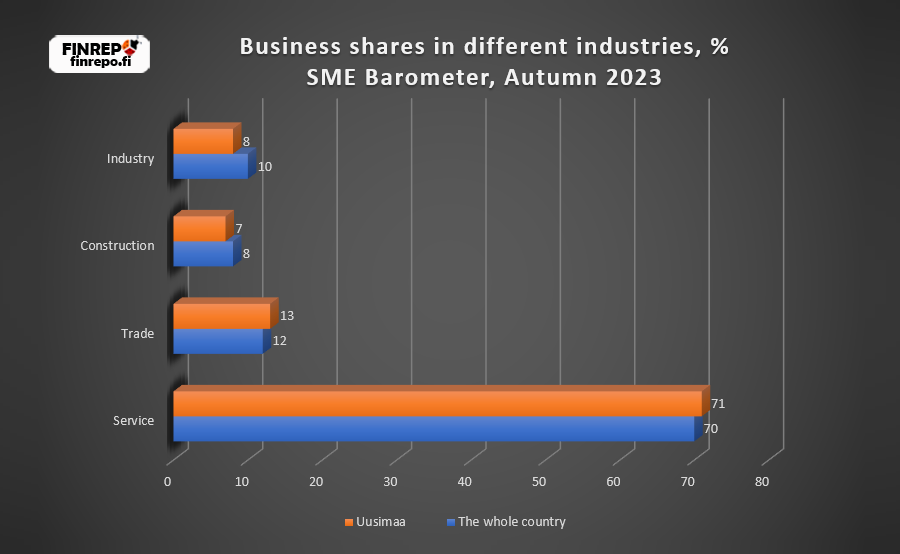
Business shares in different industries of the Finnish economy, %

Share of enterprises in different sectors %, SME Barometer, autumn 2023, Region reports. In the whole country, the service companies are composed 70%, trade 12%, construction 8% and industrial enterprises 10%.

In the Uusimaa (see SLIDE) region, the service business sector (71%), trade sector (13%) were represented relatively more and the construction sector (7%), industrial sector (8%) relatively less than the country as a whole.

Sources:

Opened and closed companies, 2nd quarter 2025

According to the Statistics Finland, 12 380 new companies have started their business in the 2nd quarter 2025 (from April to June) and 10 794 companies have closed their business.

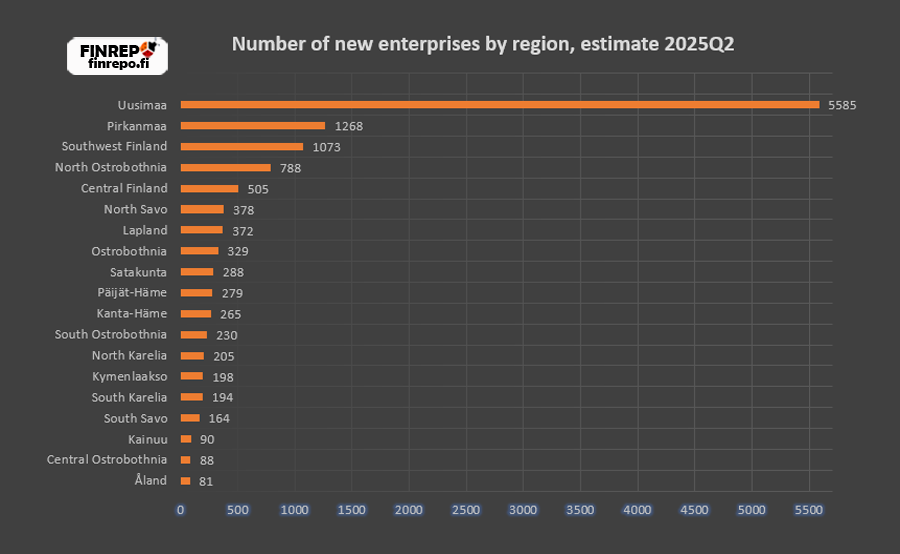
Enterprises openings by region, 2nd quarter 2025

The number of enterprise openings in the April to June period of 2025 were at 18,1 % higher than in the corresponding period of 2024. According to the Statistics Finland (Published: 10 October 2025 and 22.08.2025).

This refers to businesses that actually began operations during the period:

  • 12 380 new companies started their business in the second quarter of 2025 (compared to 10 480 in 2024Q2). Compared to the corresponding period of the previous year, enterprise openings increased by 1 900, or 18.1%.
  • Based on a regional survey, the number of enterprise openings was highest in Uusimaa in the second quarter of 2025 – 5 585 and in Pirkanmaa – 1268.
  • Between April and June 2025, there were 12 380 enterprise openings and 10 794 enterprise closures. During this period, the number of openings exceeded closures by about 1 600, or 14.7%. The transportation and storage sector played a key role in this growth: the number of enterprise openings in this sector rose from 1 286 in 2024Q2 to 3 342 in 2025Q2, an increase of 2 056 openings, or roughly 160% compared to the previous year.

Refers to all companies that are legally registered in the Business Information System (YTJ) during a period:

  • 16 955 new enterprises were registered during the second quarter of 2025. So, the total number of newly registered enterprises increased from 14 192 in 2024Q2 to 16 955 in 2025Q2, showing a growth of 2 763 enterprises (+19.5%).
  • Among the registered enterprises, 5 267 were limited companies and 11 580 were sole proprietors.
  • Sole proprietors rose from 9,386 to 11,580, an increase of 2,194 enterprises (+23.4%).
  • During the second quarter of 2025, a total of 5 267 limited companies were registered, compared with 4 694 in the corresponding period of 2024. This represents an increase of 573 companies, or about 12.2% year-on-year.
  • Limited partnerships showed a small rise from 44 to 45 (+2.3%).
  • Co-operative societies decreased from 24 to 19 (−20.8%).
  • General partnerships (42) and other legal forms (2) remained unchanged

Closed companies in the 2nd quarter 2025

According to Statistics Finland, in the second quarter of 2025:

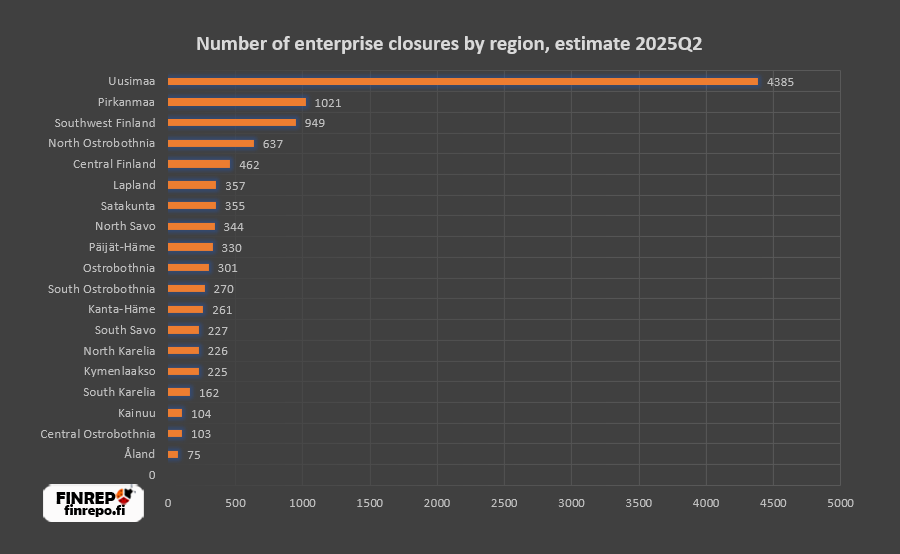
  • In total, 10 794 enterprises were closed in 2025Q2, compared to 9 140 in 2024Q2, an increase of 1 654 closures. The number of companies that had been closed was 18.1% higher than in the corresponding period in 2024. Enterprise closures increased notably nationwide, marking a continuation of the upward trend already visible in late 2024.
  • Uusimaa recorded the highest number of closures — 4,385 in 2025Q2, up by 692 enterprises (+18.7%) from 3,693 in 2024Q2. The region accounted for 40.6% of all closures nationwide.
  • Pirkanmaa had the second-highest number with 1,021 closures, increasing by 159 (+18.4%) year-on-year.
  • Southwest Finland (Varsinais-Suomi) ranked third with 949 closures, a rise of 116 (+13.9%) compared to the year before.
  • Lapland showed the sharpest relative increase — closures rose from 246 to 357, up by 111 enterprises (+45.1%), the highest growth rate in the country.
  • Only South Ostrobothnia saw a decline in closures, from 281 in 2024Q2 to 270 in 2025Q2 (−11, or −3.9%).
  • Enterprise closures increased across almost all industries in Q2 2025, indicating broad structural adjustments and tighter business conditions. The largest absolute increases were recorded in construction, professional and technical activities, and transportation.
  • The construction sector recorded the largest absolute increase, with closures rising from 1 111 to 1 467 (+356, or +32%), reflecting continued pressure from higher costs and weaker housing demand.
  • Professional, scientific and technical activities remained the largest single category of closures (1 693 in 2025Q2, +17%), accounting for nearly 16% of all closed enterprises.
  • Accommodation and food services experienced a significant rise — 354 → 474 closures (+33.9%), likely reflecting persistent cost pressures and shifts in consumer behavior.
  • In contrast, human health and social work activities saw a decline in closures (808 → 591, −26.9%), and other service activities (e.g., hairdressers, repair, personal services) dropped sharply from 408 to 221 (−45.8%) — indicating greater stability or fewer business exits in these fields.
  • Most recent publications at Statistics Finland website

  previous page   next page