Productization. Product and Service Creation

Do you have an idea for a new product or a concept for developing an existing one? The next step is to understand which customer need your offering addresses, how it differs from other market offerings, and how it can be developed.
Productization helps turn an idea, an existing service, or a company’s internal capabilities into a clear and competitive product or service that can be offered to the market.
This article examines the product as one of the key elements of a business plan. It covers the concepts of products and services, the product concept, the product life cycle, productization, new product development, and sources of ideas for improving a product. At the end, you will find questions to help prepare the business plan section “Product or Service Features”.
What Are a Product and a Service? Product Concept and Life Cycle
Product is a good, service, or other offering created to satisfy a customer’s actual or potential need. It may include both tangible and intangible components.
When the tangible component predominates, the offering is a physical product, or good — a tangible object that can be touched, such as food, a car, a book, shoes, or a pen. Such a product is a result that can be described by specific characteristics and usually has a defined price.
When the intangible component predominates, the offering is a service, or service product. A service is an activity or process through which the customer receives a particular benefit or result. Examples include education, consulting, marketing, auditing, and data processing. Unlike a physical product, a service can be more difficult to describe and standardize in advance because its outcome may depend on the customer, the circumstances, and the way it is delivered.
When developing a product, it is important to understand not only what you offer, but also what value the customer receives.
Product Value for the Customer
A product has value not only because of its characteristics. What matters to the customer is the benefit they receive and how well the offering meets their expectations. Therefore, when developing a product, it is useful to look at it from the customer’s perspective:
- what problem the product solves;
- what need it satisfies;
- what benefit the customer receives;
- why this benefit matters to the customer.
Understanding product value helps identify which characteristics are genuinely important to the customer and create a clearer offering.
Product Concept. Different Levels of the Product Concept
![Different levels of the product concept]()
A product can be considered more broadly than simply a good or service. An offering may include additional characteristics, benefits, support, and other elements that create value for the customer.
The multi-level product concept can be used to analyse your own offering and competitors’ products. It helps identify the core need the product satisfies, the additional benefits the customer receives, and which elements of the offering can be developed further.
Product Life Cycle
![Product Life Cycle]()
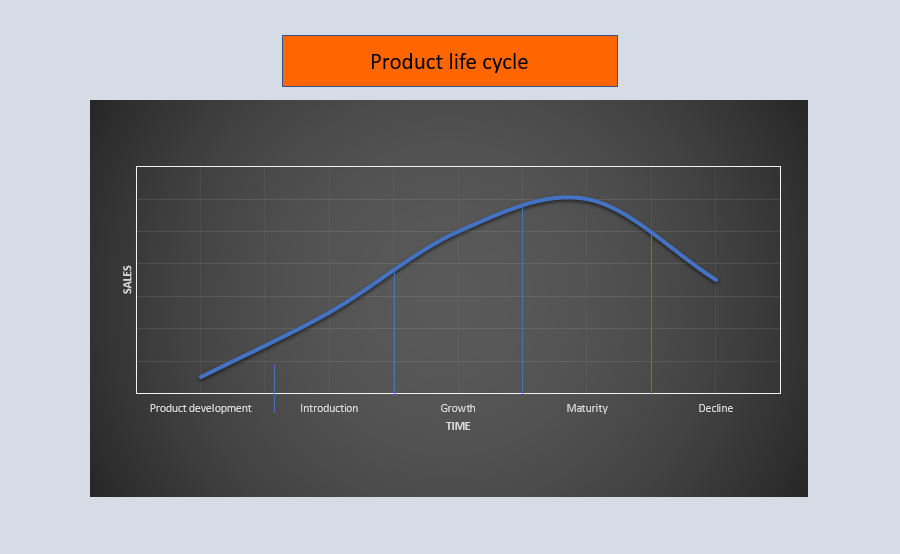
A product goes through development and market launch, after which its market life cycle usually includes periods of growth, maturity, and possible decline in demand.
The diagram shows the main stages of the product life cycle: development, introduction, growth, maturity, and decline in demand. Sales volume can change at different stages: after a product enters the market, sales may grow, then stabilize, and eventually decline.
Customer needs and the company’s priorities change at different stages of the life cycle. During development, the product must be prepared for market launch; during introduction, the company needs to attract its first customers and build demand; during growth and maturity, it must maintain sales and competitiveness.
![Product Life Cycle, Turnover and Cash Flow]()
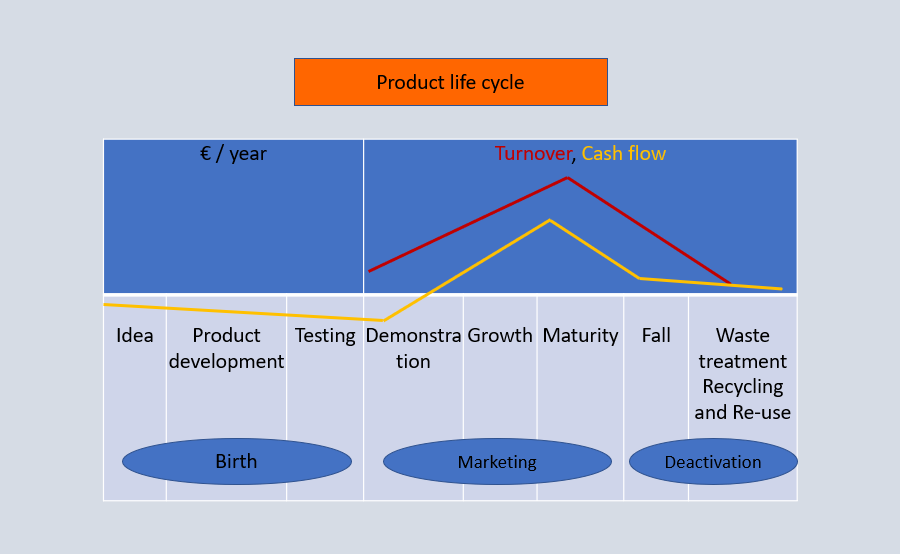
A more detailed diagram shows that the life cycle is not only about sales volume. Turnover and cash flow also change at different stages, while the company’s activities involve product development, marketing, and decisions about what to do after demand declines.
After demand declines, it may be necessary to update or redesign the product or find an opportunity to reuse it. It is therefore important to monitor the stage of the product life cycle and plan its further development in advance.
Understanding the life cycle makes it possible to plan product development in advance rather than wait until the existing offering no longer meets market needs.
Productization: Creating and Developing a Product
Productization is the process of shaping a product or service by structuring and adapting the offering to customer needs.
Productization is based on turning an idea, an existing service, or the company’s internal capabilities into a clear and commercially viable offering. It may involve transforming an existing service or concept into a product, as well as improving its characteristics, quality, and efficiency.
Productization should not be confused with production: its main purpose is to create a commercial offering that is clear to the customer and ready for the market.
Benefits of Productization
Productization can help a company:
- create competitive advantages and improve business efficiency;
- scale the business by serving more customers without a proportional increase in time requirements;
- make the offering clearer and more predictable for the customer.
For example, existing software developed for individual customers can be transformed into a standard software product for a broader market. A consultant can complement one-to-one consulting with ready-made courses that can be sold to a larger number of customers.
The Productization Process
![The Productization Process]()
The productization process consists of several interconnected elements that help turn a service or idea into a clear market offering. It may include identifying the target group and customer need, designing and testing the service, pricing, selecting distribution channels, marketing communications, and brand development.
At the same time, it is important to match market needs with the company’s capabilities. Creating and delivering a product may require appropriate resources, knowledge and skills, technologies, production or operational capabilities, partners, and other necessary conditions.
The process does not end when the product reaches the market. The company should monitor changes in customer needs, technology, and the competitive environment and update the offering when necessary.
Ideas for Developing New Products and “Weak Signals”
Even a successful product may eventually need to change. Technologies, materials, customer requirements, and the competitive environment are constantly evolving. Therefore, a company should not only create new products but also look for opportunities to improve existing ones.
An idea of an “ideal” product can be developed based on research, surveys, and customer feedback. This helps identify which product characteristics are most important to consumers and use this information in product development and positioning.
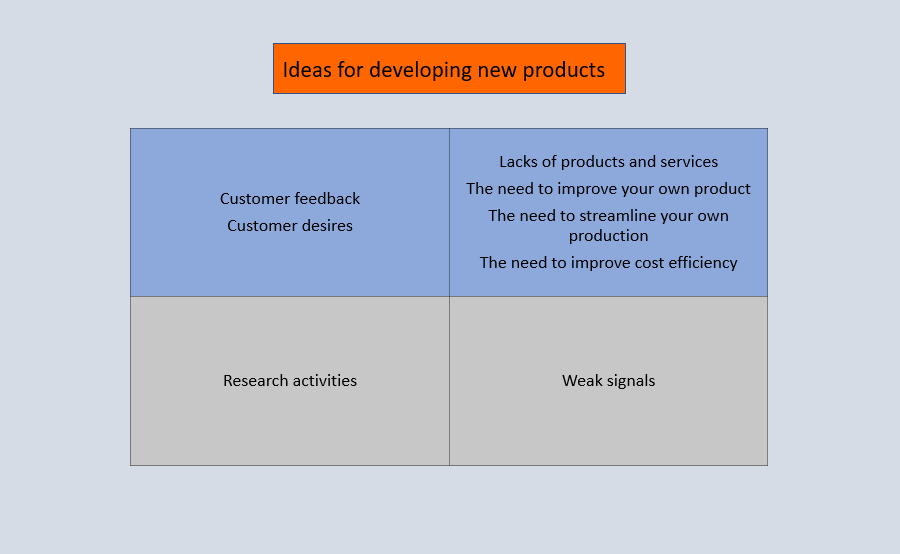
Where Can Ideas for New Products Come From?
![Ideas for developing new products]()
When developing new products, it is important to:
- focus on customers’ needs and wants and create a customer feedback system;
- study the shortcomings of existing goods and services and use the information to improve them;
- conduct research to understand consumer needs;
- monitor changes in the external environment and respond to “weak signals” in a timely manner.
Weak signals
Changes in the external environment do not always happen suddenly. Sometimes small signs of future changes appear first, and these can be difficult to notice and assess correctly. “Weak signals” are early and not yet clearly defined signs of change in the business environment. They may point to events that could become significant in the future. Analysing weak signals can help identify potential problems and new opportunities early and then adapt the product to changing circumstances.
Examples of such signals are easy to identify in hindsight, but much harder to recognize in the present and assess for their potential future impact. It is therefore important to continuously observe the market, customers, technologies, and other changes in the business environment. Weak signals may point both to emerging threats and to new opportunities for product development.
Identified needs, market changes, and new opportunities can provide a basis for developing or improving a product.
Product Development: From Idea to Testing
![Creating a New Product]()
A new product usually starts with an idea that gradually develops into a specific customer offering. Its development may include several stages, from generating the idea to testing and commercialization.
Creating a New Product
One possible process includes the following stages:
- development of a new product strategy;
- idea generation;
- preliminary evaluation and selection of the most promising solutions;
- business analysis;
- product development;
- market testing of the product;
- commercialization.
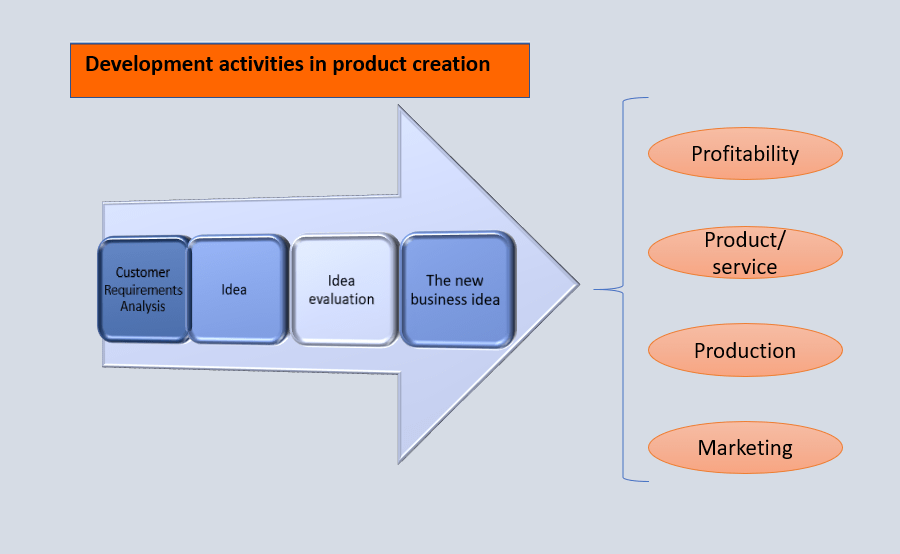
This is not a rigid framework: the number and sequence of stages may vary depending on the company and the product. Product development requires consideration not only of the sequence of stages, but also of factors that influence the product’s further development and market performance.
![Product Development Activities]()
-
Customer Need.
During development, it is necessary to determine what problem the product solves, which characteristics are important to the customer, and what value it creates.
-
New Needs.
Another situation is also possible: an innovative product may have characteristics that create a new customer need and contribute to the emergence of a new market.
-
Economic Feasibility.
When developing a product, it is important to compare expected costs with the anticipated result and assess whether the product can be produced or the service provided at an acceptable cost.
-
Market and Commercialization.
Even a good product must fit market conditions and be understandable to potential customers. Product development therefore involves not only technical or functional characteristics, but also how the product will be presented to the market.
Product Testing
Before launching a product, it is important to test the main assumptions:
- whether the offering meets customer needs;
- whether the product or service can be created and delivered;
- which product characteristics are most important;
- whether it can be produced or delivered at an acceptable cost;
- whether the conditions for commercialization exist.
Market research, feedback from potential customers, product testing, and other validation methods can be used for this purpose.
For more information about finding, selecting, and testing a business idea, see the separate article “Starting a Business in Finland: From Business Idea to Business Plan”.
Business Plan Section: Product or Service Features
![Product or Service Features]()
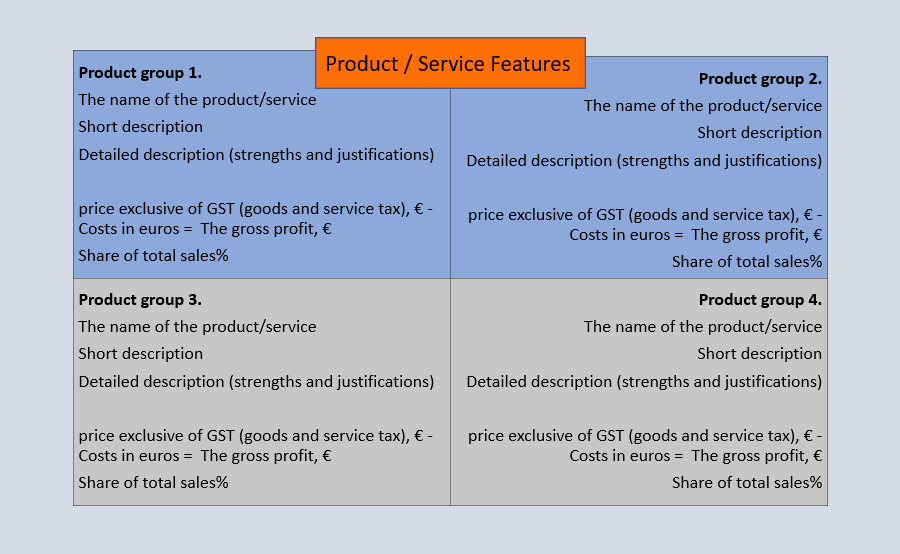
If you are planning to launch a new product or develop an existing one and intend to present your offering in your business plan, this section should clearly explain what you offer the customer, what value the product or service creates, how the offering differs from others, and why a customer should choose it.
In a business plan, information about products or services can be presented by individual product groups or categories. For each offering, it is useful to provide its name, a brief description, key characteristics, and other information needed for its evaluation. Where appropriate, the description can also include the price and expected sales volume. This information can also be used when preparing the financial section of the business plan.
This structure helps organize the information and compare the main parameters of several products or services. If a company offers several product groups, each can be described separately together with its specific features.
When preparing this section of the business plan, answer the following questions.
1. What are your products or services?
Briefly describe the main products or services offered by the company.
2. What does your product or service consist of?
Describe exactly what the customer receives: the main product characteristics, the components of the offering, and the format or method of delivering the service.
3. What customer need does the product or service satisfy?
Describe what problem the offering solves and what benefit the customer receives.
4. What distinguishes your product or service from competitors’ offerings?
Describe 3–5 of the most important characteristics, benefits, or features that make the offering attractive to the customer.
5. What are the weaknesses of your product and/or service?
An honest assessment of weaknesses helps identify opportunities for further development.
6. How would you change, develop, or improve the product if you had additional resources?
Consider which changes could increase the value of the product for the customer.
7. How would you explain the need for the product and its benefits to the customer?
If the product provides an economic benefit, you can give a simple calculation.
8. How can the product or service develop in the future?
What changes, new characteristics, product variants, or additional services may be needed as customer and market needs change?
A product description connects the business idea with the company’s practical activities: it shows what the business offers to the market, what value it creates for the customer, and what future sales and financial calculations will be based on.