The absence of money is one of the first issues that very often arises when an entrepreneur decides to organize his
own business. This is a very common problem, when you have a business idea, desire, aspiration and even business plan but
there is no money to start and set up a company. You should not abandon your idea at once and try to look for external
sources of financing, because profitable ideas are interesting to all. Do not despond if the lack of money is the only
thing that prevents you from starting a business! There are enough variants where money can be taken. Let's consider some
possible alternatives where to find money for your business in Finland.
Finland is a country with great opportunities!
![Cash flow statement]()
Financing, Cash Flow Statement
The financial plan is the most important section of the business plan. It has to generalize all previous parts of
the business plan and to represent them in terms of money.The purpose of the calculation is to plan and understand the
amount of operating costs and investments before starting a business.
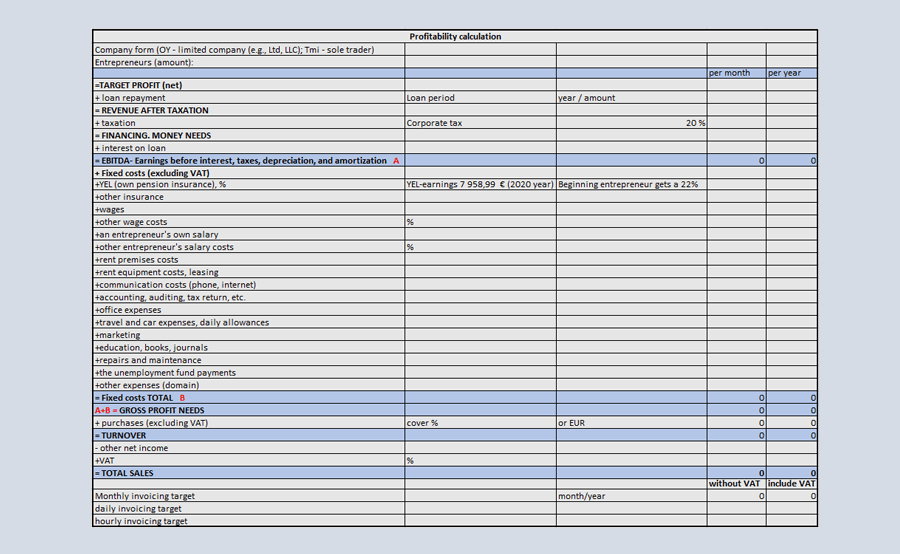
![Profitability calculation]()
Profitability. Profitability calculation
Business requires costs! Every entrepreneur, investing in a new project, expects to get a profit. Profitability of
the business is an indicator that assess the efficiency of investment. You do not need to know much about finance or be
an economist if you are going to calculate the profitability of your business. It will be enough to have a basic data
and do simple calculations.
![Sales' calculation creating]()
Finance. Sales' calculation. Task for thinking
One of the main indicators of the effectiveness of the company is gross margin. Analysts pay particular attention to
this indicator, which assesses the profitability of a company. The gross margin can be obtained by subtracting the
amount of costs for manufacturing products from the sales proceeds. You can complete the price information in the table
and calculate margin.
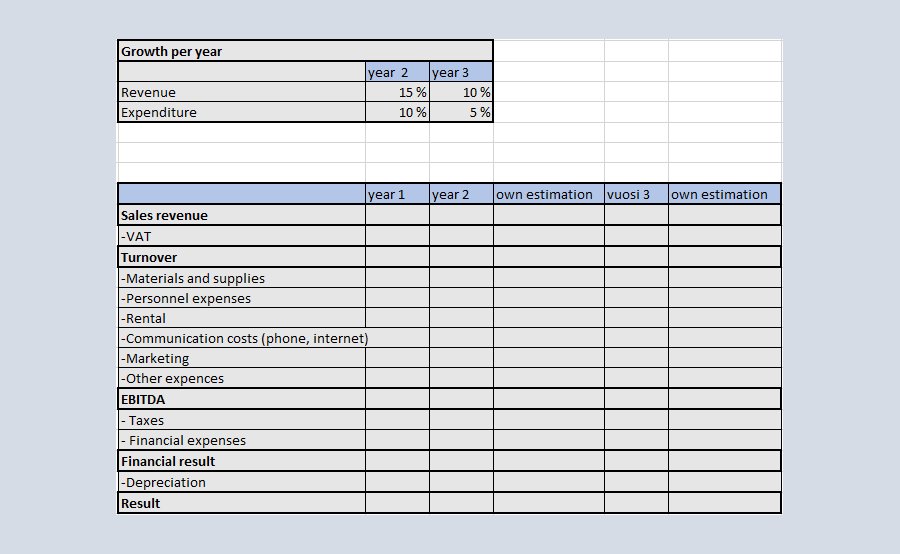
![Growth per year]()
Financial Plan for 3 Years
You can plan and predict how your revenue as well as your expenses and profitability will develop in the coming
years. You can calculate the future expected growth of the company. This is the easiest way to make predictions for
future years.
Funding a new business. The money to start a business
In the development of a successful business it is very significant to find the sources of financing. Discover some
available ways to finance a start-up business in Finland:
- Own capital
- Loan capital
- Friends and Family
- Loan financing - bank loans, finance companies, insurance companies, business angels
- Finnvera Oyj, Finnish Industry Investment Ltd (Suomen Teollisuussijoitus Oy) , The Finnish Innovation Fund
Sitra
- Business Finland - Tempo
Financing, EU Financing
- Invention Foundation (Keksintösäätiö), Entrepreneurship incubators ( Yrityshautomot )
- ELY Center (Centre for Economic Development, Transport and the Environment) - for example, start-up assistance
- Centres for Economic Development, Transport and the Environment support the establishment, expansion and
development of small and medium-sized enterprises by providing counseling, training and financing
- TE offices - Money to start a business: Start-up Grant
- And others. You can find useful links for funding here
Start-up Grant (Starttiraha). TE -office or Finnish Employment and Economic Development Offices
TE Offices are public employment and business services (TE-toimisto: Työ- ja elinkeinotoimisto). These offices provide
free of charge services for jobseekers in Finland. This is a state-operated organization that assists: to find а work, to get
financial aid if you are out of work, to plan and choose a career, to get an education and start an entrepreneurial
activity.
Thus, Starttiraha or Start-up Grant provided by the Finnish Employment and Economic Development Offices (TE Offices), paid by the KEHA Centre:
- the state-provided income support for the entrepreneur
- is intended for a new entrepreneur, who pursue a full-time entrepreneurship
- can also be granted for several entrepreneurs who work at the same company
- can be granted if entrepreneur does not get any other subsidies and does not have any other source of income except income from
start-up business
- personal, taxable income paid to the entrepreneur for his living expenses
- provide the entrepreneur's livelihood for the duration of the business formation but for a maximum of 12 months
- the amount of grant is equal to the amount of a basic unemployment allowance
You can get a financing for your start-up if:
- you are an unemployed jobseeker
- you are not unemployed, but you decide to become a full-time entrepreneur, for example, after paid work, studying or
homework
- the TE- office grants funding for start-up business if it has determined that this is a suitable alternative for the
jobseeker to employ
- See startup grants
The conditions for obtaining a grant include:
- full-time entrepreneurship
- sufficient competence for conducting a business
- opportunities to do a profitable business
- the necessity for livelihood assistance
- the possibility to start a business only after the financial support has been granted
Financing, Cash Flow Statement
In order to receive additional financing, it is necessary to draw up a financial plan, which is the most important section of the business plan. It has to generalize all previous parts of the business plan and to represent them in terms of money. The purpose of the calculation is to plan and understand the amount of
operating costs and investments before starting a business.
A schematic description of the Cash Flow Statement can be viewed in the following picture, where:
- The "money needs" part describes how much money is required to start a new promising business. It also describes the
starting period, where sales revenue may not be sufficient, but there are, however, costs, such as telephone bills, own
revenue needs, salaries, rents etc.
- The "money sources" part describes the sources of money available for the company. The calculations, for example, can
provide the data about the amount of the loan needed, how much is possible to obtain and what kind of other funding is
available.
- The calculations reveal the entrepreneur's own financial contributions as well as the proportion of existing equipment
and different operating tools (so-called non-monetary property, in Finnish: apporttiomaisuus).
- The financial risks, needs and costs associated with starting operations can be balanced, planned and evaluated in
euros.
A more detailed description of a monthly cash flow report, as well as a template for its preparation and calculation in Excel format, can be viewed on our website in the section "Company's cash flow statement".
Profitability. Profitability calculation
Business requires costs! Every entrepreneur, investing in a new project, expects to get a profit. Profitability of the
business is an indicator that assess the efficiency of investment. The calculation of this indicator is an important part in drawing up the financial section of a business plan. You do not need to know much about finance or be an economist if you are going to calculate the profitability of your business. It will be enough to have a basic data and do simple calculations. A schematic description of the profitability calculation process can be seen in the following picture. Thus, profitability calculation:
- helps you to figure out the sales volume that should be in your company to make your business profitable
- it can be compared to a separate sales budget (which estimates how much sales you can do from the planned customer
base)
- considers the costs related to business operations regardless of sales:
- expenses are listed line by line and counted together
- defines the time needed for work, such as working hours per week, monthly, etc.
- shows how much sales the firm must have at a certain time in order to be profitable and to generate sufficient
income for the entrepreneur's needs
- the result can be compared to the sales forecast
A more detailed description of the process of profitability calculations, as well as other main indicators of the financial condition of the company, can be found on our website in the section "Financial Analysis".
Business plan section: Finance. Sales' calculation
One of the main indicators of the effectiveness of the company is gross margin, which is also calculated as а part of the preparation of the financial plan. Analysts pay particular attention to this
indicator, which assesses the profitability of a company. The gross margin can be obtained by subtracting the amount of costs
for manufacturing products from the sales proceeds. To calculate sales, you can fill the price information in the table and calculate margin separately for different groups of goods, as well as calculate the final result.
You can also find an Excel template for such a calculation in the "Calculation of gross margin for separate types of products" section. First of all, define the price of a company's product and/or service. The information about how to set the correct price for a product can be found further in the section "Service and product pricing" and "Price level selection" .
The key questions for which you should be ready to answer when setting a price for a product or service. These questions can help to prepare business plan, define
business strategy and achieve goals.
- What is the general price level for similar product/service on the market?
- In the case of expert service or project-specific work, create a few examples of prices for some similar services.
- How much will your product/service cost and why have you chosen this pricing model? Make a price list for your products
and services as an attachment to your business plan.
- What is the margin structure of your product and what does it consist of?
- How much you will get as a profit from the selling price after the expenses coverage? Provide an example
calculation.
- How much your product/ service should cost to get your business profitable? (per day, week, or month) (Compare with
profitability calculations)
Financial Plan for 3 Years
You can plan and predict how your revenue as well as your expenses and profitability will develop in the coming years. There is no standard form of financial plan for an enterprise and you can assume the expected growth using the following table. Compiling a financial plan is the easiest way to make predictions for future years. A financial plan is often drawn up for several years in advance and then adjusted and revised as needed. Some notes to the table:
- if there are any changes in costs that deviate from the previous one, you can input your new estimates next to the cost
item
- the financial result indicates the amount of money at the end of the reporting period and is an indicator of business performance
- the result may differ from what was previously presented
- "EBITDA" - Earnings Before Interest, Taxes, Depreciation and Amortization
Business plan section: Accounting and financial planning
In most cases, the entrepreneur is most likely focuses on business results and prefer to entrust bookkeeping, payroll and financial planning
to the specialized accounting firm. He trusts the experts while planning of financial reporting. It is a good idea to deal
with a professional auditor, however, the planning, monitoring and development of the actual business is always the
responsibility of the entrepreneur. You have to think about these questions before starting your business:
- How are you going to do your bookkeeping?
- How much you will pay for accounting every month?
- How are you going to plan your work?
- What tools you are going to use?
- How often have you been thinking about planning your business?
- Where and how often do you follow the implementation of the plans?
- What you are going to do if your plans will fail?
- How are you going to arrange funding? How long does it take to get additional finance? Consider where does the company
intend to get finance? Explain why you came to such decision.
- How to arrange payment transactions? How you will manage your bank account? Accounts and Payments, Money
Management?
- Loans and guarantees? Insurances?
- How long does it take to reach the required sales level according to your plans?
- Do you need an advice on budget planning or anything else?
- Where do you plan to apply for advice?
Consider the questions above to help articulate business ideas and plans!
Service and product pricing, the goals
The pricing policy is the art of managing price and the art of setting the right price for goods (services) depending on
market situation in such way, that all business goals (strategic, operational) would be achieved. Product pricing is not only an
important factor that determines the profit, but also a crucial condition for the successful sales of products and services.
Some notes about the price:
- it is a measure of product / service value: the price indicates the value of the product to the customer
- it has an affect to profitability: each additional euro from sold product will enhance profitability
- it is a factor that affects the positioning of products: the price will divide the product to the different target
groups
- price is a fundamental factor affecting competition: increase or decrease the competitive edge of the company
THE MAIN DEFINITIONS AND FACTS ABOUT THE PRICE
- Price is the service / product value
- Price is a quite visible tool of competition and it is easy to react on it
- The right price is one that the customer is willing to pay for the service / product based on its quality
- Price is an important means of competition and it is directly affects the company's profitability
- The customer often does not know how the price is formed, but the price is considered as a quality indicator
- The high price may limit sales, but on the other hand, it attracts customers for whom the price is not the primary
buying factor
- Low prices can attract customers to buy, but company gets less money. Everyone can sell cheaply, but only successful
entrepreneur can sell profitably!
Price affecting factors
The level of the prices and price changes of goods depend on many factors, differing by origin, measure of influence, sphere
and time of action etc. The factors that determine price fluctuations can be divided into internal and external. Internal
factors depend on the enterprise while external do not depend on it.
INTERNAL FACTORS may be the following:
- product costs
- specificity of the production process
- the need to cover long-term capital investments
- effectiveness of advertising activities
- the level of quality of the products and its uniqueness
- limited production resources
- product characteristics, such as, raw materials, design, individuality
- company and product reputation
- etc.
EXTERNAL FACTORS, for example:
- total demand in the market for certain product. The demand-supply ratio. Demand or product desirability:
- if the demand is high and the product is limited, an entrepreneur may establish a higher price
- take into account the buyer's ability to pay and "price sensitivity": how easily the buyer can change the product
if the price changes
- what can affect on the demand?
- - necessary things always have a demand (food and clothing)
- - does the buyer pay the product himself or someone else pay?
- - in a hurry the price may not necessary be a crucial factor
- availability on the market of similar goods
- the price for similar products of the main competitors, thus the impact of competitors on the price
- quality of competing products
- seasonality of consumer demand
- taxes, State Regulation and Legislation (e.g. the price for tobacco products is regulated by the Ministry of Social
Affairs and Health)
- level and rate of inflation
- segmentation of the market
- market size
- etc.
The cumulative impact of all these factors leads to the establishment of prices that ensure the balance of economic
activity.
Company's main objectives, which can be achieved by the changes of price:
- Increase sales: the price has to attract buyers
- Increase profit: the price must be higher than costs
- Increase market share: discounts, advantageous offers and prominent advertising
- To keep high reputation: service / product should not be too cheap
Price level selection
One of the most important questions that come to entrepreneur's mind: "What price should I set for my product?". The price
should not scare your potential consumers, should maintain the competitiveness of the goods and at the same time cover the
costs of production. An entrepreneur may choose one of the three options compared to competitors:
- high price: novelty, high quality
- average price: price close to competitors' prices
- low price: the customer is attracted through different offers and discounts
Price as an instrument of competition policy or price discrimination
The point of price discrimination is the setting of different prices for the same goods or services for different segments of consumers. The main idea is to capture a maximum share of a consumer market. Price discrimination means a technique for dealing with a large market. When a company uses the price as a competitive tool, it must make some decisions, for example, define:
- the basic price
- price changes: price level or gradation; price through the system of discounts
Price changes
The price gradation or price level means that the same product has different price to different buyers. Thus, we can get also
buyers even outside the actual target group. It is possible to make the following separation:
- time gradation: date, time, pre-order
- buyer gradation: age, loyalty, a certain group
- regional/area gradation: from a certain zone
Psychological pricing
The role of psychological sensing of price is very important! There are some useful tactics when setting of the price:
- Non-rounded price. This is a widespread practice which means that you use numbers that end in 5 or 9, thus, little
below the price: 9,90 €, 995 €, 4,99€
- Price for a small amount of product: 1,95 € / 100g
- Amount limit: only 1 pc / customer
- A discount in euro or as a percentage, whichever looks like more preferable (for example, a discount of 4,00 € for
socks -40% instead of 1,60 €)
- If you sell products online, it is better to separate the cost of product and delivery (0,01 € for product + 3,99 €
for delivery)
Discounts
- mean an offer in the form of better price (price decreasing)
- discounts must be distinguished from actual pricing
- important principle: There are no discounts without argumentation and solid grounds!
The discount can be based on:
- the amount of goods purchased (annual discount)
- the size / volume of single purchase
- the campaign or pre-order
- the customer grouping
All promotional campaigns must comply with the laws and regulations of the authorities. In Finland there are some
RESTRICTIONS:
- the discount price should not be higher than the original price. The discount is calculated from the price previously
levied on the same store and on the same product, immediately prior to the new discounts introduction. (
Consumer Protection Act / Kuluttajansuojalaki).
Read also the information related to the
Reform of the Consumer Protection Act that brings changes to the regulation of consumer credit and online payments.
- the discount campaign can last up to 3 months during year and not more than 2 months at a time
- advertising must clearly indicate the duration of the offer
- in an advertising the price and the product must match each other
- in an advertising must be a picture of the right product!
If a discount cannot be provided to the client, the different other offers may be allowed to the customer, for example,
credit card, credit or longer payment period. More about the rules of giving discounts in Finland you can find on the website
Finnish Competition
and Consumer Authority.