Marketing and advertising are crucial parts of a successful business. If you do not have a marketing system, then you
should expect that your sales will move very slightly and you will not have a substantial progress in your business. So,
what marketing and advertising mean? Marketing is the product sales management process on the basis of various analyzes
and researches, as well as through promotional tools, including advertising and PR (Public Relations).
Advertising is the direction in marketing, where the goal is to spread information about particular goods in order to
attract maximum attention to it.
Finland is a country with great opportunities!
![Maslow's hierarchy of needs]()
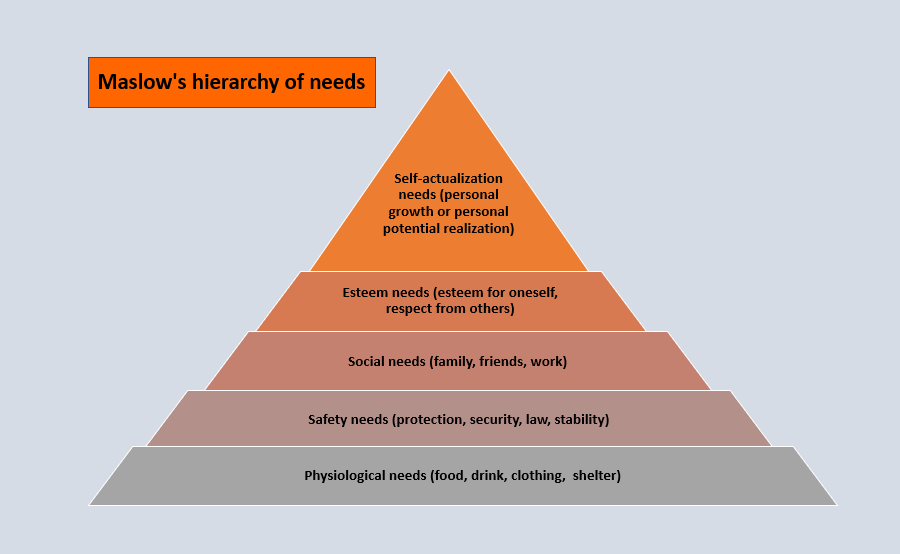
Maslow's hierarchy of needs
You and your business integrated in a single whole. The stages of business development easily fit into the framework
of Maslow's motivational theory. How a person's needs influence his motivation in business according to the theory of
Abraham Maslow? The hierarchy of needs A. Maslow is one of the most famous theories of motivation in psychology.
![Marketing as an integrating element of business]()
Marketing in practice. Marketing as an integrating element of business
Marketing plays a very important role in business success, it helps to manage profits and improve the sustainability
of the business through marketing solutions. Integrated marketing is based on the unity of external and internal
marketing.
![Segmentation]()
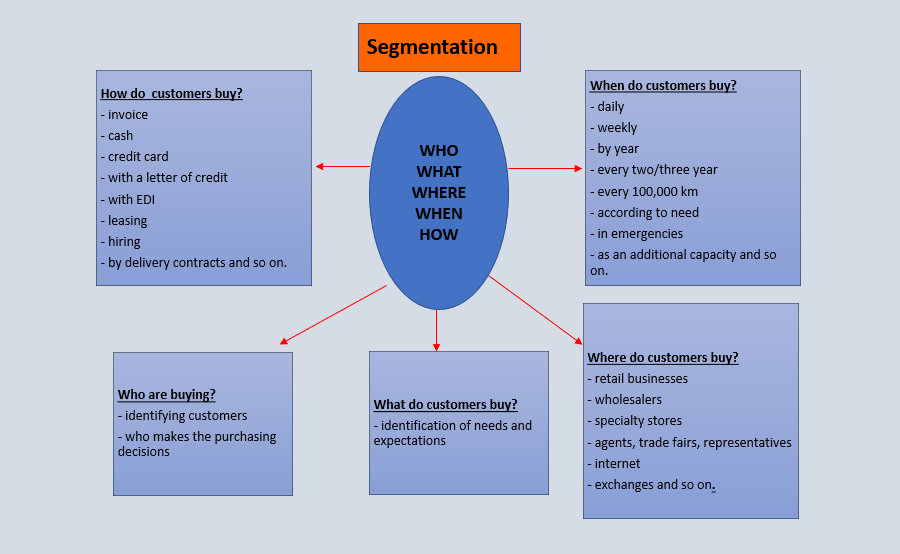
Segmentation with basic questions. Letter of credit (LC) and Electronic data interchange (EDI).
The aim of marketing research of products and their characteristics is to obtain the most complete and reliable
information about the buyer's judgments concerning defined services or goods. When carrying out the analysis of a
relevant market, it is necessary to get answers for the following questions: WHO, WHAT, WHERE, WHEN and HOW.
![Internal marketing]()
Internal marketing
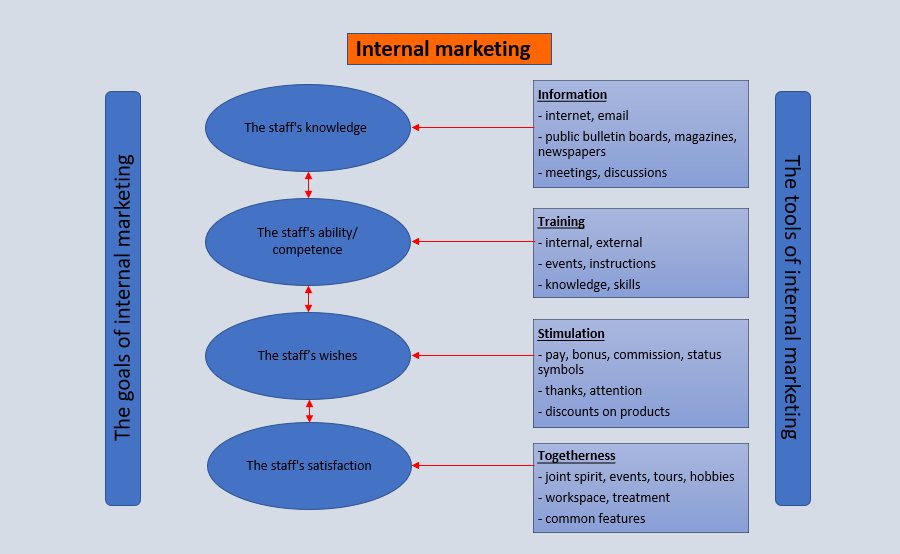
Internal marketing is based on a regular interaction with employees to create a positive background for achieving
company's goals. Тhe company offers the employee a product that consists of a position, duties and wages. The employee
acquires this product, paying for it with his own labor.
Key concepts in marketing
- Consider the main concepts of marketing!
-
- Market: customers who want to buy your products.
- Demand: the amount of products/services, which the customers want to buy in a given period of time in a specific
business area. The willingness to buy a particular product or service.
- Consumption: actual demand, which means what people buy in reality. The company seeks to forecast demand in order
to plan its own business and find niche markets.
- Sphere of influence: the geographic area from which the customers come. The different types of companies need a
different size of the geographic range areas.
- The market area may be even global or very limited.
- The size of the market is not decisive for profitability, the most important are segmentation and the right
marketing measures.
The basics of Marketing
- Marketing is based on the company's vision of the future
- quick response to the rapid technology change
- the need to collect information about changes
- Customer relationship focusing
- Building permanent customer's relationships, loyal customers groups
- Customer target groups or segments
- Market and product analysis
- The competitor analysis
Maslow's hierarchy of needs
You and your business integrated in a single whole. The stages of business development easily fit into the framework of
Maslow's motivational theory. How a person's needs influence his motivation in business according to the theory of Abraham
Maslow? The hierarchy of needs A. Maslow is one of the most famous theories of motivation in psychology. It is based on the
results of numerous psychological studies. Human needs have several levels from the simpler to the higher. Striving for
higher needs, as a rule, occurs after satisfying the needs of a lower order (for example, food and safety.)
Competition. Fundamental competition tools in marketing.
Competition is a rivalry between organizations on the market. It is an "invisible hand" that regulates the entire
economy. Competition is one of the most important ways to increase efficiency of the whole economic system. The analysis of
competition is necessary for choosing of a correct direction of development.
- Only a few companies have no competitors at all
- Competition is, in addition to demand, an essential factor in the company's operating environment
- Very often occur a situation when there is demand and there are customers in the industry, but competition may be so
severe that it is impossible for a new company to enter the market
- Stand out from other companies is the only way to find your own place in the market! Segmentation!
CONCEPTS OF COMPETITION
- Sales potential
-
the total sales forecasted by the industry as a whole, from which the companies receive their share
- Sales of the industry
-
sales of the company + sales of competitors
- Market share
-
sales of the company's share of total sales in the sector (calculated as a percentage)
COMPETITIVE SITUATION
In any market there are competing companies that offer similar products and which satisfy the specific needs of a given
market or market segment. Competition can take many forms. Each company should conduct a competitive analysis, carefully
investigate its existing and potential competitors. The competitive situation may be the following:
- The company has core competitors, these companies operate in the same field
- There are competitors, which may operate in a completely different industry but satisfy similar needs
COMPETITIVE ADVANTAGE
The company's ability to act on the market depend on the company's competitive advantage. The development of competitive
advantages of the company is based on its goals and objectives, which are achieved in accordance with the position of the
company in the market of goods or services. Competitive advantages:
- make the company recognizable in the market and protect from the effects of competitive forces
- are the characteristics or properties of the product, which create for the firm a certain superiority over its direct
competitors
- is the advantage and attractiveness that customers may have by comparing your product with that of a competitor. The
competitive advantage of any enterprise is any exclusive value that it possesses and which gives it superiority over its
competitors
Competitive advantage can be:
- monetary advantage (for example, low production costs)
- functional advantage, (good product characteristics or quality)
- reputational advantage (trademark with good reputation)
The roles of competitors. Competitive companies have a variety of roles:
- Market leader: the highest market shares; with good reputation and well-known products
- Adapter: Usually modifies the products of the leader. Very often he starts with other markets to avoid a direct clash
with the Market leader
- Imitator: make the same goods with Market leader, but keeps the differences in packaging, advertising, prices
etc.
- Cloner: Copies the leader's products, distribution system, an advertising company, but can slightly modify the brand
name.
- Counterfeiter: Duplicates the leader's product and packaging, selling goods on the black market or through
intermediaries with doubtful reputation
Key marketing elements. Marketing-mix: 4 P model
The key marketing elements can be classified according to the 4 P model: marketing-mix model. The marketing mix model includes all the
necessary parameters of the product, which can be controlled and developed for the effective promotion of goods on the
market.
- Product (or service): a set of products and services, which the company offers in the market.
- Price: the amount of money that consumers must to pay to receive the goods.
- Place (availability): means that the goods of the company must be present on the market in the right place and at the
right time.
- Promotion (Marketing Communication): all possible company's activities, which help to disseminate information about
the product and to attract the consumers attention to it.
-
And there is a fifth point, especially in а service companies:
People: people related to the purchase and sale
process. 5 P’s are key marketing elements.
1. Product
Product - can also be a service
- From a company's point of view: what a company sells
- From a customer's point of view: what a customes buy
- The term "commodity" (in Finnish: hyödyke), which emphasizes the benefits (hyötyä) of the product (motivate the
customer to buy)
- The product range and the related service proposition (the user's instructions or maintenance)
- Products can be grouped according to the purchase method (groceries, consumer goods, specialty goods, luxury goods,
consumer goods, production goods etc.)
Product brands or branded products
- Brand means the name, term, symbol, logo or design, or their combination It is the company's product symbol used to
distinguishes the product from competing products.
- Seller's obligation is to continuously provide the customer with a set of features, benefits, and services.
- Brand perception is influenced by the buyer's experience and the company's efforts to strengthen the brand.
- The oldest brands in Finland have been created over 100 years ago (e.g. Fazer Kiss-Kiss Candies from the late 19th
century)
2. Price
- Product Value Measure
- The right price means: what the customer is willing to pay; the quality of the product must be reflected in the
price
- An important tool of competition (it is easy to react to it; directly affects the company's profitability)
- Low prices can attract customers to buy but you will get less money
- Anyone can sell at a low price but just a real trader sells profitably!
3. Place
Place - forms of direct sales
External and internal availability:
- external: the consumer knows how to reach the company; store location, web site, easy to go
- internal: shop interior/environment, product placing, finding at website. Availability: customers have what to
buy
A marketing channel, a chain or a distribution channel using which the goods move from the manufacturer to the store and
to the consumer.
- physical distribution
- logistics
Place – availability
- Order by post (some people prefer to shop at home)
- The customer buys the goods either by telephone, by mail or via computer. He makes online shopping
- Network marketing
- Door-to-door marketing
- Home Invitations
Place - online and mobile sales
- The customer orders the products via the internet. Payment is made directly from a bank account, credit card or
invoice.
- Mobile marketing means marketing through mobile phones. The mobile phone acts as a marketing channel and marketing
specialists must remember that the phone is a very personal tool and try to avoid being annoying
4. Promotion - Marketing Communication
- Promotion
- Advertising
- Personal selling
- Relationship and information activities
- Direct Marketing
5. People
- Everyone is the business card of their company
- Make an emphasis on customer service
- The quality of marketing service depends on the staff. Customer experience gives an idea about quality: expectations
– experiences; trust/confidence
Marketing in practice. Marketing of a start-up company
Who is more successful in the market: the modern start-up or a big corporation with a huge level of experience in the
particular field and which have got already loyalty from customers? In fact, both have chance of being a market leader, in
case, if the company has chosen and use the right marketing. There are some things you should take into account when set up
a business:
- Marketing Budget. How to do a good marketing budget?
-
- Is it possible to conduct business without a marketing budget? Yes, but not a long time, especially if you are a
small company. The company's future development is impossible without marketing planning!
- Marketing Activities. What kind of marketing activities you can implement and use?
-
- Marketing communications (direct advertising, information, display advertising)
- Internal and external marketing
- The service environment (facilities, comfort, functionality)
- Service process (service success, speed, high quality, customer appreciation, expertise)
- Marketing Tools. What kind of marketing tools you should use?
-
- Sales work and other customer service process management
- Marketing communications
- Customer Relationship Management (loyal customer, new customer service)
- Client registers
- Monitoring your competitors
- Marketing planning
- Feedback collections
- Continuous renewal
Marketing as an integrating element of business
Marketing plays a very important role in business success, it helps to manage profits and improve the sustainability of
the business through marketing solutions. Integrated marketing is based on the unity of external and internal marketing.
The integrating function of marketing allows to coordinate all phases of the business and to increase the effectiveness of
interaction of all actions to achieve the required result.
Marketing in the company becomes a profit center and is integrated into business management. As a result, all key
decisions are made taking into account the marketing strategy. Every company operates under conditions of dynamically
changing environmental factors. The main task of marketing management is to react in time for any changes in company's
environment. The goal of marketing is to identify, analyze, evaluate these changes and be able to adapt the enterprise's
activities to new conditions, using the most profitable market opportunities.
Marketing targeting or segmentation
Segmentation of the market is one of the functions in the marketing system. It means the activity to identify potential
groups of consumers for a particular product. Segmentation of the consumer market has two objectives: it helps to identify
the category of customers, to which the main efforts will be directed and to detect the category of the market with the
minimal competition. The success of the firm in the market depends not only on finding their own segment, but also on
ability to find and occupy a vacant place in the market and, as a result, take an own niche in the market.
- Segmentation answers the question to whom the product / service has to be sold.
- The organization may consider five different ways how to target your marketing to different segments.
- Focus on one segment (the most vulnerable)
- Selective specialization (several attractive segments)
- Product specialization (the company focuses on manufacturing a specific product that it sells to several
segments)
- Market specialization (the company strives to serve the needs of one specific customer group)
- Covering the whole market. If the competition in the market is not very high, then the company will try to work
in all segments, using various marketing tools.
Segmentation with basic questions
The aim of marketing research of products and their characteristics is to obtain the most complete and reliable
information about the buyer's judgments concerning defined services or goods. When carrying out the analysis of a relevant
market, it is necessary to get answers for the following questions: WHO, WHAT, WHERE, WHEN and HOW.
SEGMENTATION WITH BASIC QUESTIONS
- Who are buying?
- What do customers buy?
- Where do customers buy?
- When do customers buy?
- How do customers buy?
SEGMENTATION SCHEME
Letter of credit (LC) and Electronic data interchange (EDI)
Let's consider a little more detailed the segmentation section “How do customers buy a product or service?”, various forms and methods of payment, in particular, letter of credit (LC) and electronic data interchange (EDI).
LETTER OF CREDIT (LC)
A letter of credit (LC) is one of the most reliable and profitable bank instruments used in concluding contracts. The
letter of credit is convenient to both the seller and the buyer. A letter of credit is a special account to be opened in
the bank, where you can reserve money for transactions to make sales of goods or services. The bank pays the necessary
amount to the beneficiary's (recipient) account if both parties fulfill the conditions stipulated in the contract.
This is the foreign trade payment method whereby the bank undertakes to pay the debit notes agreed by the trading
parties. A letter of credit is internationally accepted payment method, governed by the uniform rules of the International Chamber of Commerce.
Types of letters of credit
There are several types of letters of credit. They differ in their functionality, so the customer can choose the most
suitable for themselves. By way of securing payment, it can be covered and uncovered:
- Covered. It is opened for transfer of money from the account of the client-sender at their full availability. It is
secured with funds belonging to the customer in a special account.
- Uncovered. It is used when there is a correspondent account of the beneficiary's bank in the bank of the sender. The
receiving bank writes off the money from the account, and the executing bank then receives it from its client, to which
it provided a guarantee. It is offered within the limit of the customer’s credit.
It can be also:
- Revocable. The payer can cancel it if the recipient of the money has not fulfilled his duties.
- Irrevocable. It can be canceled only on the initiative of the recipient. This type of letter of credit cannot be
canceled or changed without the consent of the recipient of funds (Seller).
- Confirmed LC. Regardless of the payment made by the Bank (issuer) opening the letter of credit, the Bank confirming
the letter of credit is responsible for the fulfillment of obligations.
- Unconfirmed LC. The responsibility for payment under this letter of credit takes only the Bank that issued the letter
of credit.
- Stand-by LC. It is used in situations where the Buyer is not able to fulfill its payment obligations to the Seller,
the Bank executes the letter of credit.
- Transferable LC. Allows the Seller to transfer a certain part of the letter of credit to the other party (parties).
It is convenient in case if the seller is not the only producer of the goods and also buys a part of it from third
parties. It is not needed to open several letters of credit in favor of third parties.
- There are also Back-to-Back LC, Payment at Sight LC, Red Clause L.
ELECTRONIC DATA INTERCHANGE (EDI)
EDI billing is used in business-to-business transactions. By using EDI, i.e. electronic data interchange, the invoice is
delivered directly from the vendor's information system to the customer's information system. The customer's information
system compares the invoice to the delivery and ordering documents. Then, the invoices found to be valid are paid, which
can also happen automatically.
Internal marketing
Internal marketing is based on a regular interaction with employees to create a positive background for achieving
company's goals. Тhe company offers the employee a product that consists of a position, duties and wages. The employee
acquires this product, paying for it with his own labor. Thus, the employee becomes an internal consumer of the company and
he has to get the same attitude as the external client. Internal marketing of the company certainly is no less important
than the external.