Starting a Business in Finland: From a Business Idea to a Business Plan

A successful business starts with an idea, but an idea alone is not enough. Before starting a company, it is important to understand what need the business will meet, who its customers will be, how its offering will differ from competitors and how the business will generate revenue.
The next step is to turn the idea into a specific business concept and assess its strengths and weaknesses, opportunities and risks. Based on this work, you can prepare a business plan that helps organise the goals, actions and financial calculations of the future business.
On this page, we look at the main stages of developing a business idea in Finland — from finding and initially evaluating an idea to testing it, developing a business concept and preparing a business plan.
A business plan is a written plan that describes a company's business concept and shows how it will be implemented in practice. It can describe the product or service, customers, market, competitors, required resources, risks and financial indicators.
A business plan is primarily a tool for the entrepreneur themselves. It helps test the business concept, identify weaknesses and make decisions in advance that may affect the development of the company.
At the same time, a business plan makes it possible to present the future business to potential investors, financiers, partners and other interested parties. It may also be required when applying for financing or when applying for a start-up grant (starttiraha). More information about the content and purpose of a business plan can be found on the official Suomi.fi portal.
A business plan usually covers:
However, preparing a business plan does not necessarily have to be the very first step. First, it is necessary to work through the business idea itself: determine what exactly the company will offer and whether the offering has realistic prospects.
Finding and testing a business idea
Finding a business idea is the first step towards a future business. An idea may arise from your own professional experience, observing the market, identifying a problem or discovering a need that existing products and services do not yet satisfy well enough.
When choosing an idea, it is important to consider not only your own interest in it, but also its practical value for potential customers.
Choosing a business idea
![Choosing a business idea]()
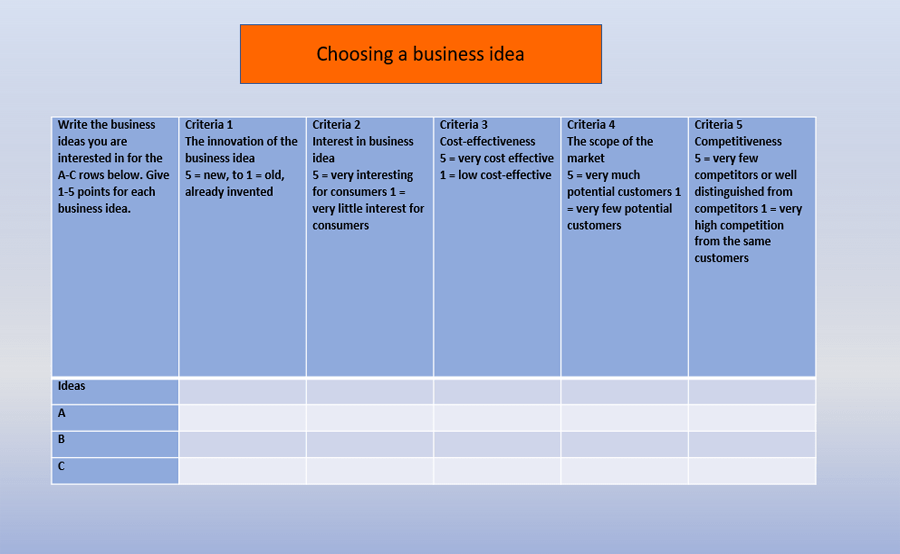
When choosing an idea, it is useful to evaluate several options and compare them using the same criteria. For example, you can consider:
- how new or innovative the idea is;
- how interesting it may be to potential customers;
- how economically viable the business could be;
- how large the potential market is;
- how strong the competition is likely to be.
To make the comparison more objective, you can create a simple evaluation table. Each business idea can be assessed according to the selected criteria, for example on a scale of 1 to 5 points. The results can then be compared to determine which ideas appear to have the greatest potential.
In the table below, each idea is evaluated separately according to several criteria. The higher the total score, the more attractive the idea appears based on the selected indicators. However, such an assessment does not guarantee business success; it helps structure the initial analysis and identify ideas that are worth examining in more detail.
Testing a business idea
After initially selecting the most promising idea, it should be examined in more detail to determine how well it corresponds to real market needs and whether it can be implemented in practice. At this stage, it is necessary to move from a general idea to more specific questions about the future business.
For a more detailed evaluation of the idea, it is useful to answer the following questions:
- What will the company produce or what services will it provide?
- What benefit will the customer receive and what customer need will the product or service address?
- Who will the potential customers be?
- How large is the potential market and which target groups may be interested in the offering?
- Who is already offering similar products or services?
- How will the future business be able to differentiate itself from competitors?
- How will the future business make money?
It is also important to understand whether the potential market is large enough for profitable operations and whether the entrepreneur has the necessary knowledge, skills and resources to implement the idea.
After this initial assessment, it is useful to organise the information obtained and look at the business idea from different perspectives. One tool that can be used for this purpose is a SWOT analysis, which helps assess the strengths and weaknesses of the business idea itself, as well as external opportunities and threats. This analysis makes it possible to identify not only the advantages of the project, but also potential problems and factors that may affect its development.
As a result, the initial assessment of a business idea consists of several stages: first, different ideas can be compared using the main criteria, then the most promising idea can be examined in greater detail, and finally its strengths and weaknesses, opportunities and risks can be assessed using a SWOT analysis.
SWOT analysis of a business idea
![SWOT analysis of a business idea]()
SWOT analysis is a logical continuation of the initial assessment of a business idea. It helps organise the results of this assessment and consider the future business from the perspective of both its internal characteristics and its external environment.
The name SWOT is formed from four English terms:
- S — Strengths — advantages of the business idea or future company;
- W — Weaknesses — internal shortcomings and limitations;
- O — Opportunities — external circumstances that may support business development;
- T — Threats — external factors that may create problems or risks.
SWOT analysis is particularly useful after the initial evaluation of an idea because it allows the information collected to be brought together in one framework. For example, the entrepreneur's professional experience, a unique product or good knowledge of a particular customer group may be strengths. Lack of financing, missing skills or high dependence on a single supplier may be weaknesses.
Opportunities may include growing demand, the emergence of a new market or changes in consumer behaviour that create additional demand. At the same time, increasing competition, rising costs, changes in legislation or dependence on certain market conditions may represent threats.
Thus, SWOT helps not only to list the advantages and disadvantages of an idea, but also to consider how to use existing opportunities and prepare in advance for potential threats.
SWOT analysis does not provide an automatic answer to the question of whether a business will be successful. Its purpose is to help the entrepreneur identify the main factors that should be considered when making decisions and planning further activities.
Once the idea has passed the initial assessment and its strengths and weaknesses, opportunities and potential threats have been identified, the next step is to understand exactly how the future business will operate. This can be done by developing a business concept that connects the selected business idea with a practical model for implementing it.
![Business concept model]()
A business idea shows what the entrepreneur wants to create, while a business concept helps determine how the idea will work in practice, how it will create value for the customer and how it will generate revenue.
When developing a business concept, it is important to connect the main elements of the future business:
- what the company offers — a product or service;
- for whom the offering is intended — target customers;
- what need it addresses;
- how the company will operate and interact with customers;
- what resources and competencies are required;
- what costs are associated with the activities;
- how the business will make money;
- how the offering will differ from competitors.
Thus, a business concept helps to look at the future business as one system rather than as separate elements. It allows you to check whether the offering, customers, ways of working, required resources, costs and sources of revenue are consistent with each other.
If at this stage it becomes clear that the offering does not provide enough value to the customer, costs are too high or the way of generating revenue is not realistic enough, the business concept can still be changed before preparations to start the business begin.
The business concept becomes the link between the initial idea and the future business plan. Once the main elements of the business model have been developed, the next question is how to protect the results created by the entrepreneur if they have commercial or intellectual value.
Protecting a business idea
Not every business idea can be protected by itself. A simple idea, a desire to create a particular product or a description of a future business is not an invention that can automatically be patented.
However, individual elements of a future business may be eligible for legal protection. Depending on the situation, this may be a technical solution, the appearance of a product, a trademark or another intellectual property right.
Patent (Patentti)
A patent can protect a new technical invention that meets the established patentability requirements. In particular, the invention must be new, involve an inventive step and be industrially applicable. (PRH)
Before filing an application, it is important to check whether the invention is new. For a preliminary search of existing patents, you can use the Patent Information Service PRH and Espacenet. PRH also notes that disclosing an invention before filing an application may affect its novelty.
Design right (Mallioikeus)
If the competitive advantage is primarily related to the appearance of a product, design registration can be used to protect it. The protection covers the appearance of a product subject to the conditions established by law.
More information about design registration and protection is available on the PRH website.
Utility model (Hyödyllisyysmalli)
A utility model can be used to protect certain technical solutions and is another tool for protecting intellectual property.
In Finland, a utility model is registered with PRH. The maximum term of protection for a utility model is 10 years. More information about utility models is available on the PRH website.
Trademark (Tavaramerkki)
A trademark allows the goods or services of one company to be distinguished from those of other companies. Therefore, a brand name, logo or other sign used in commercial activities may have significant value for a business.
In Finland, national trademarks are registered by PRH. Before filing an application, it is also useful to check existing trademarks in the Trademark Information Service of PRH.
The Finnish Trademarks Act Tavaramerkkilaki 544/2019 entered into force on 1 May 2019. Current information about the legislation can be found on the PRH website and in Finlex.
The ® symbol is used to indicate a registered trademark. The TM symbol may be used to indicate a trademark, but by itself it does not mean that the mark is registered.
Thus, intellectual property protection is part of overall business planning. Understanding which elements of a project need protection makes it possible to take related risks and costs into account in advance.
From a business idea to a business plan
![The first 6 steps for creating your business plan]()
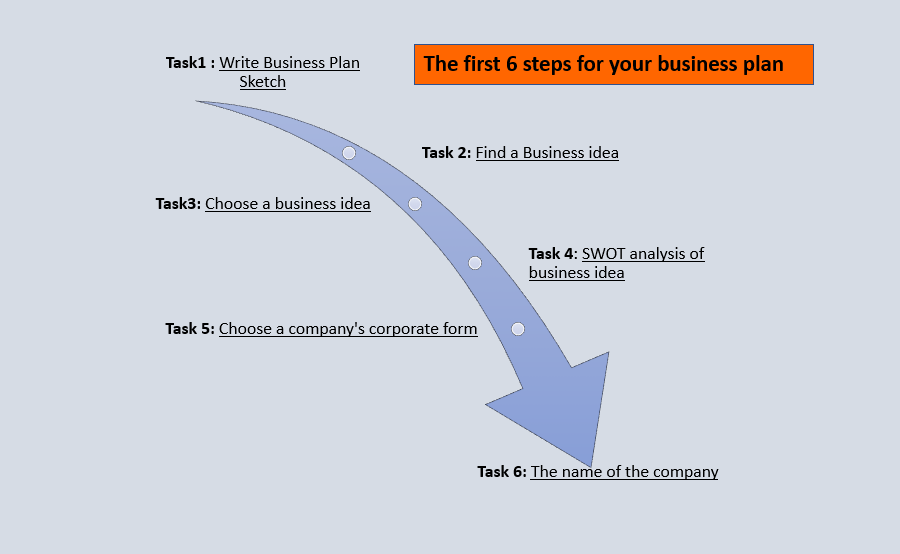
Developing a future business is a step-by-step process. First, you need to develop and select a business idea, check whether it meets market needs, assess its strengths and weaknesses, opportunities and threats, and then determine exactly how the future business will operate.
The diagram below shows the main stages of this process. The first four steps — finding and selecting a business idea and analysing it — are covered on this page. The following stages are already related to the practical establishment of a company: choosing a suitable legal form of the business and a company name.
Thus, choosing a business idea and testing it are only the beginning of the process. Once the idea has been sufficiently developed, it is necessary to determine the appropriate legal form of the business and choose a company name.
Last updated: 14 August 2026