Business plan creation. Structure and scheme

Finland is the best country for Startups!

Business plan creation. Structure and scheme

Do you intend to create a business plan? There comes a time for strategic planning? You can do this work successfully using our business plan framework. There is no standard form for making business plans however, there are some typical questions, the answers for which should be included into your strategic plan.

You can create an effective business plan with our step by step guides regarding marketing and advertising, funding, taxation, business risks and insurance, accounting etc. The detailed description, overviews and explanation of each part of a business plan can be easily found at our website. The following framework will help you to execute your business plan and reach the goals in your future business.

Finland is a country with great opportunities!

Company name, contact information and company form

  • Name of the company (check if name is free at PRH)
  • Contact information
  • Contact person
  • Phone
  • Address
  • E-mail
  • Domain name www. .fi (check if domain is free at traficom)
  • Company type

Business background information

Background information e.g.:

  • Where the business idea came from? or How your business idea came up?
  • Describe your future business in a nutshell.
  • You can also use pictures

Read more on our website in sections:
"Finding a business idea and its testing. Protecting the business idea"
"Different forms of entrepreneurship in Finland. Forms of a legal entity"
"The establishment of the company. Select a company name"

Entrepreneur's education, skills and competence

For example, describe the following areas of expertise:

  • Education
  • Training
  • Work experience
  • Language skills
  • Computer skills
  • Other special competences, abilities
  • Hobbies

You can use the following questions to describe your areas of expertise and strengths. Remember to be honest with yourself.

  1. What kind of work experience and education do you have?
  2. What kind of entrepreneurial experience or education do you have (e.g. entrepreneurship courses)?
  3. Do you have any specific skills, knowledge or abilities which can bring you benefits as an entrepreneur?
  4. How do you plan to take advantage of your experience, education and expertise for your business?
  5. What are your strengths?
  6. How are you going to take advantage of your strengths?
  7. What are your weaknesses and how to overcome it?
  8. What kind of education, skills or abilities do you need more? How could you get them?
  9. What kind of additional training would you think you would acquire?
  10. Where are you prepared to ask for advice if necessary?
  11. Are there any other contacts in your contact network from which you can receive advice and support if necessary?

Entrepreneurial education, skills and competence - SWOT Analysis. You can also use the SWOT analysis to describe the above-mentioned issues. Educational background and expertise, competence and skills via SWOT Analysis.

Read more on our website in section:
"Can You Be an Entrepreneur?"

Business idea selection

You have to decide and describe:

  • What do you sell?
  • To whom do you sell?
  • How do you sell?
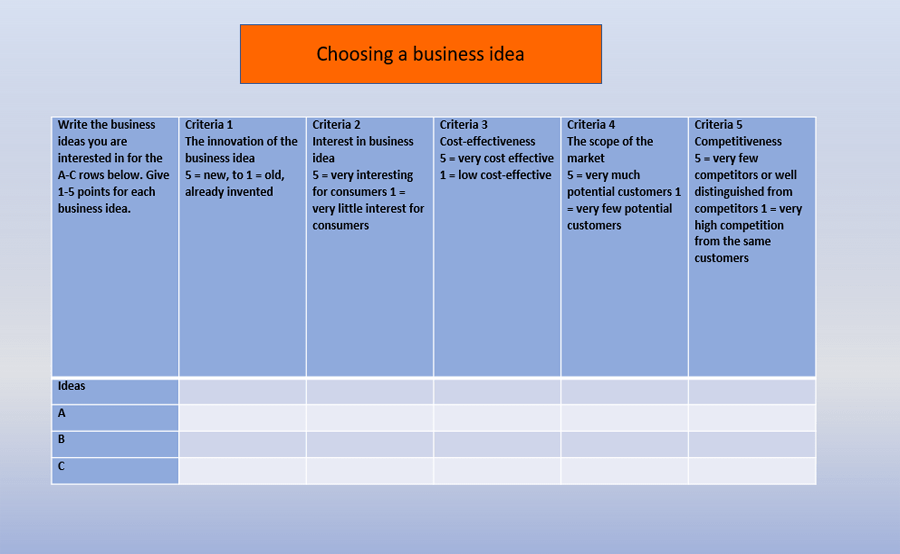
Choosing a business idea. Estimation and criteria: innovation, interest, cost-effectiveness, skope of the market, competitiveness

Business idea selection / Choosing a business idea

You have a great idea for a business but is it so worth to start it? Have you a good chance of success? You can estimate your business ideas using this table. Finding the right business idea is a crucial point in successful entrepreneurship.

SWOT analysis of business idea. Strengths, weaknesses, opportunities and threats.

SWOT analysis of the business idea

SWOT is an abbreviation for Strengths, Weaknesses, Opportunities and Threats. The SWOT-analysis table can be used to analyze and appraise the entrepreneur and company situation in relation to the market. Describe the strengths and weaknesses of your business idea as well as opportunities and threats. In each part of the table you can lists briefly the essential activities you plan to take.

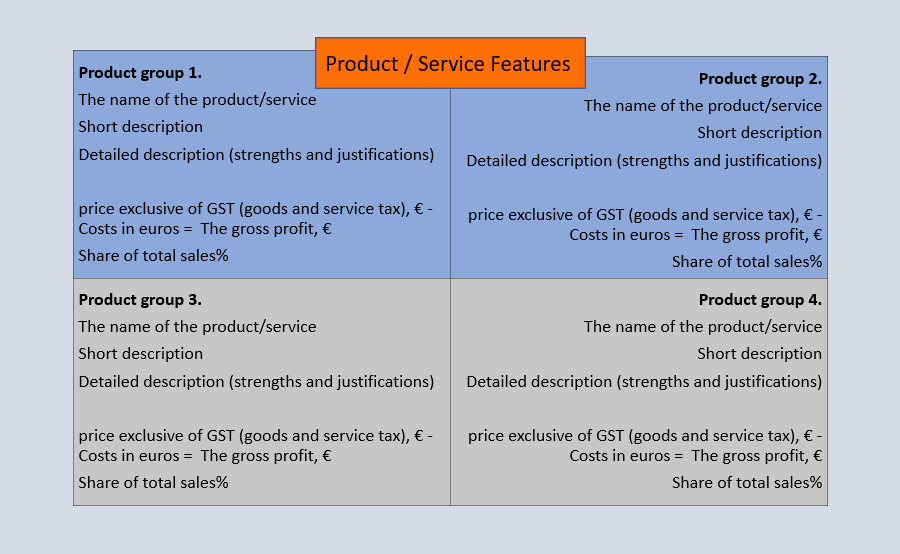
Complete your business plan's product and service section. For example, use the following questions to help. (See the slide "Product/service features" below):

  • What are your products or services?
  • Name your product, if possible (think what you want to say to your customer by the use of product name)?
  • What's unique in your product or service? Describe the most important features (3-5 things) which can show the strength of your product. Write and add them to your business plan.
  • What are the weaknesses in your product and service?
  • How would you develop them if you could get more resources?
  • What is the benefit of your products and services to the customer?
  • How do you assure your customers of the necessity and benefits of the product? Give an example (if, for example, they generate economic benefits, you can present a simple calculation).
  • Why should a customer buy your product/service? Give reasons for choosing just your product/service?
  • Complete the price information in your business plan (table)
Product service features. Gross profit and share of total sales

Product/Service Features

Complete your business plan's product and service section.

Complete your business plan: the customer's section and the market's section. Describe your own market and your customers on a general level, for example, using the auxiliary questions:

  • Who are your customers and your target group?
  • What are the customers’ buying habits/preferences?
  • Where do the customers usually find the products and services to buy?
  • What are the reasons for choosing these products and services?
  • Which things generally affect for their purchase decision?
  • How do you plan to influence on their purchasing decision?
  • Why they buy this service/product again?
  • Where are customers located?
  • How do you reach your customers?
  • How many customers are there?
  • How many customers you can effectively reach in one week using the chosen method?
  • How many you think would buy your product /service?
  • Who will make a purchase decision if your customers are enterprises/businesses? If you create B2B company.
  • How would you find the right decision maker?
  • How do you reach a decision-maker?
  • What are your negotiating mandates, means and instruments?
  • How to ensure the creation of a trade?

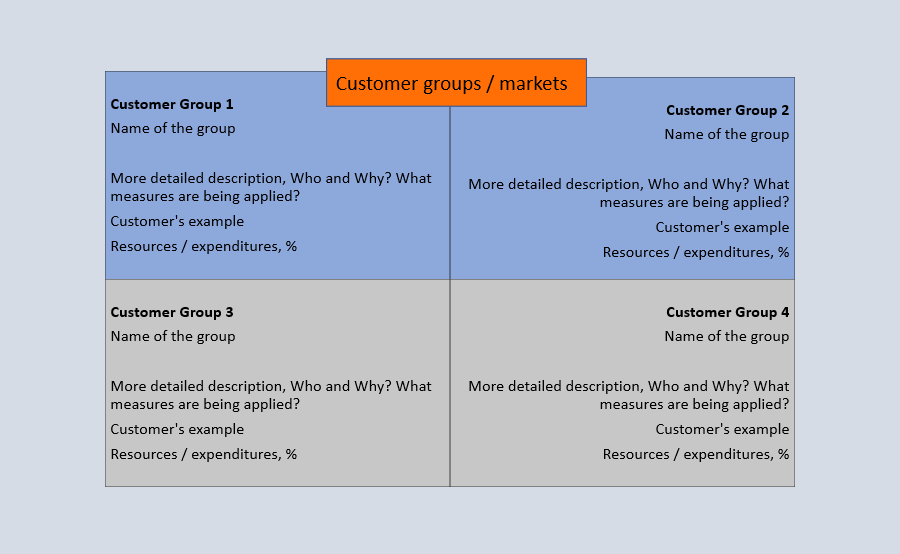
Define the 3-5 most important customer groups (See the slide "Customer groups / Markets" below). Define in percentage how much of your resources (time and money) you will spend on each customer group. Give the names of a few potential customers for each customer group. Describe briefly your customers and you will get a clear idea of who are your most important customers / customers groups.

Customer groups and markets. Detailed description, examples and expenditures

Customer groups. Markets

Define the 3-5 most important customer groups.

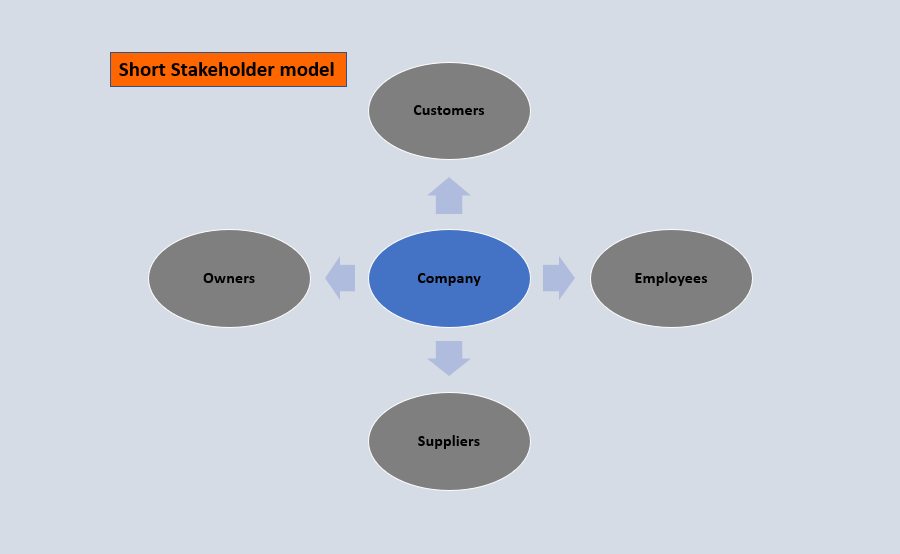
STAKEHOLDER ANALYSIS.

  1. Create a stakeholder analysis for your company with the right names of the company's stakeholders.
  2. You can describe the stakeholders in accordance with the templates presented below
  3. Remember the arguments!
Short Stakeholder model. Owners, customers, employees, suppliers affect the business

Short Stakeholder Model. Business environment

Describe the stakeholders in accordance with the template

Normal Stakeholder Model. Micro and macro environments

Normal Stakeholder Model. Micro and macro environment

Describe the stakeholders in accordance with the template

Create a marketing plan for your business:

  • Define your target audience. What is your target audience in marketing or advertising?
  • How are you going to market your product or/and service and advertise your company?
  • What kind of marketing / advertising tools do you intend to use?
  • How do you plan to take into account the special needs of customers?
  • What kind of marketing budget does your company have? How much are your company going to spend on marketing?

A more detailed description of the marketing system, can be found on our website in the section "Business marketing and advertising".

Complete the parts of your business plan concerning market and competitors. You can use the following questions for help. See the slide below.

  • What is the market situation in the industry and area of your business activity?
  • Describe the relation between supply and demand for a given product /service.
  • Have you surveyed your market? How do you survey a target market?
  • Who are your key competitors or main competing products / services? Name 3–5 most important.
  • What are their strong points / strengths?
  • What are their weak points / weaknesses?
  • How do your products and services differ from other products? how your product or service can be different from competing one?
  • How do you explain or demonstrate your strengths to your customer in relation with competitors?
  • Other distinguishing factors?
  • What kind of advertising tools and promotional measures your competitors use?
  • How you are going to attract your customers' attention? What are your competitors doing?

Market Competition - Competitors' Analysis

Market competition and competitor analysis. Strengths and weaknesses of competitors, marketing and advertising tools

Market competition and competitors' analysis

Describe briefly:

  • the strengths and weaknesses of your competitors and / or their products in relation to yours
  • how to stand out from other products or services of your competitors

Think about the following questions:

  • How are you going to arrange funding?
  • How long does it take to get additional finance?
  • Consider where does the company intend to get finance? Explain why you came to such decision.

Use the “Becoming an Entrepreneur in Finland, 2024” Guide

Financing, Cash Flow Statement

The financial plan is the most important section of the business plan. It has to generalize all previous parts of the business plan and to represent them in terms of money. The purpose of the calculation is to plan and understand the amount of operating costs and investments before starting a business.

  • The "money needs" part describes how much money is required to start a new promising business. It also describes the starting period, where sales revenue may not be sufficient, but there are, however, costs, such as telephone bills, own revenue needs, salaries, rents etc.
  • The "money sources" part describes the sources of money available for the company. The calculations, for example, can provide the data about the amount of the loan needed, how much is possible to obtain and what kind of other funding is available.
  • The calculations reveal the entrepreneur's own financial contributions as well as the proportion of existing equipment and different operating tools (so-called non-monetary property, in Finnish: apporttiomaisuus).
  • The financial risks, needs and costs associated with starting operations can be balanced, planned and evaluated in euros.

A more detailed description of a monthly cash flow report, as well as a template for its preparation and calculation in Excel format, can be viewed on our website in the section "Company's cash flow statement".

Cash flow statement. Money needs and sources

Financing, Cash Flow Statement

The financial plan is the most important section of the business plan.

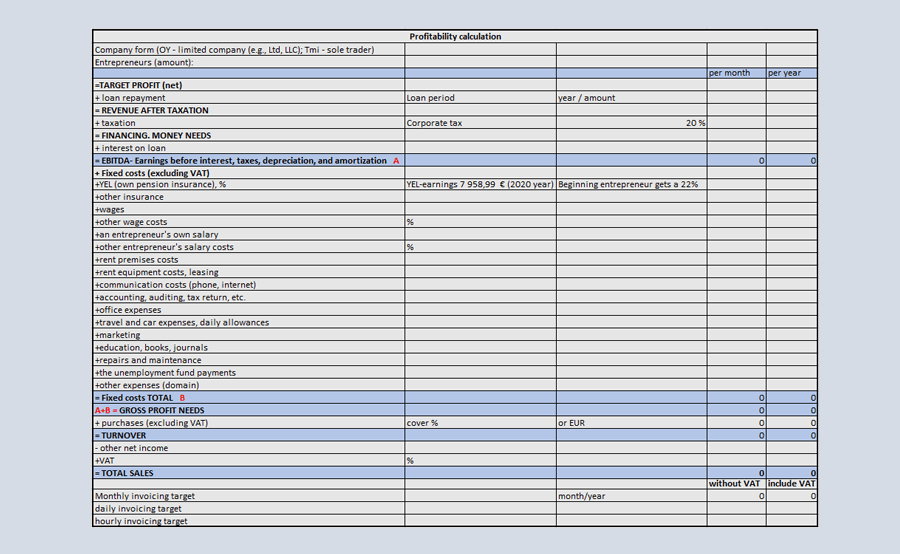
Profitability calculation. EBITDA, Gross profit needs, turnover, total sales

Profitability calculation

Profitability of the business is an indicator that assess the efficiency of investment.

Business requires costs! Every entrepreneur, investing in a new project, expects to get a profit. Profitability of the business is an indicator that assess the efficiency of investment. You do not need to know much about finance or be an economist if you are going to calculate the profitability of your business. It will be enough to have a basic data and do simple calculations. Thus, profitability calculations, slide above:

  1. helps you to figure out the sales volume that should be in your company to make your business profitable
    - it can be compared to a separate sales budget (which estimates how much sales you can do from the planned customer base)
  2. considers the costs related to business operations regardless of sales:
    - expenses are listed line by line and counted together
  3. defines the time needed for work, such as working hours per week, monthly, etc.
  4. shows how much sales the firm must have at a certain time in order to be profitable and to generate sufficient income for the entrepreneur's needs
    - the result can be compared to the sales forecast

A more detailed description of the process of profitability calculations, as well as other main indicators of the financial condition of the company, can be found on our website in the section "Financial Analysis".

Sales' calculation creating. Price, expenses and margin

Finance. Sales' calculation.

You can complete the price information in the table and calculate margin.

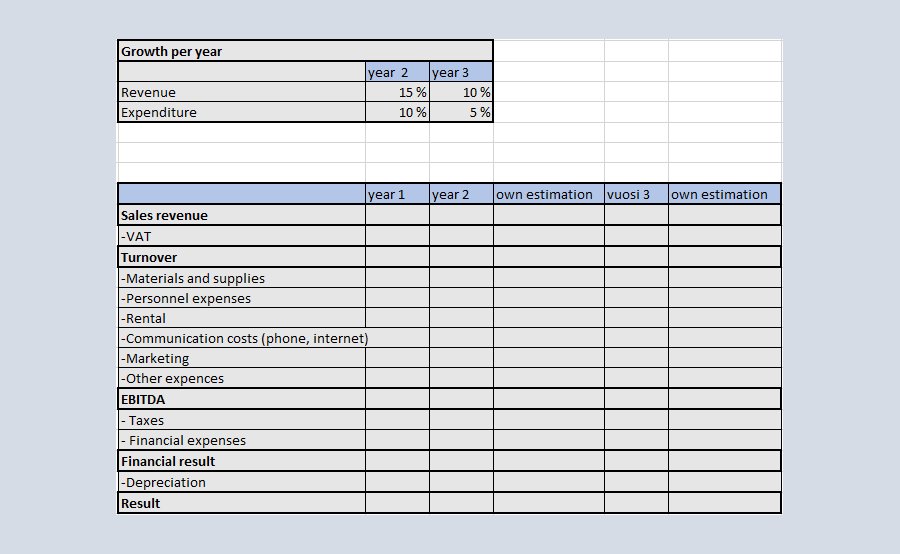
Growth per year. Sales revenue, turnover, EBITDA, financial result

Financial Plan for 3 Years

You can plan and predict how your revenue as well as your expenses and profitability will develop in the coming years.

Finance. Sales' calculation.

One of the main indicators of the effectiveness of the company is gross margin. Analysts pay particular attention to this indicator, which assesses the profitability of a company. The gross margin can be obtained by subtracting the amount of costs for manufacturing products from the sales proceeds. You can complete the price information in the table above and calculate margin. First of all, define the price of a company's product / service.

Consider the following questions:

  • What is the general price level for similar product/service on the market?
  • In the case of expert service or project-specific work, create a few examples of prices for some similar services.
  • How much will your product/service cost and why have you chosen this pricing model? Make a price list for your products and services as an attachment to your business plan.
  • What is the margin structure of your product and what does it consist of?
  • How much you will get as a profit from the selling price after the expenses coverage? Provide an example calculation.
  • How much your product/ service should cost to get your business profitable? (per day, week, or month) (Compare with profitability calculations)

Financial Plan for 3 Years

You can plan and predict how your revenue as well as your expenses and profitability will develop in the coming years. You can calculate the future expected growth using the slide above. This is the easiest way to make predictions for future years.

Taxation, Value Added Tax (VAT)

  • Find out if your business is liable to pay VAT?
  • Try to explain why your company has to pay VAT or not liable to pay it.
  • Make Value-added tax calculations using our Online VAT calculator
  • Value-added tax at vero.fi
  • Value Added Tax Act 1501/1993 (in English)

Additional information in the section "Taxation of enterprises in Finland"

Consider the following questions:

  • How are you going to manage your accounting?
  • How much have you estimated to pay monthly for bookkeeping?
  • How are you going to plan your business?
  • What kind of additional tutorials are you going to use?
  • How often have you thought about planning your business?
  • Where and how often do you follow the plans?
  • How prepared are you if your plans don't come true?
  • How do you intend to arrange funding if necessary? For how long financing enough?
  • Arranging payment transactions, how do you manage the banking issues? Bank accounts and payment, cash flow?
  • Loans and guarantees. Insurances?
  • Estimate how long does it take to get a sufficient sale.
  • Do you need advice on planning, budgeting, or anything else?
  • Where do you plan to receive an advice?

Additional information in the section: Accounting and Bookkeeping "What should be included in a company's business plan accounting section?"
READ ALSO: "Accounting and Tax legislation in Finland"

Risk factors and Risk survey

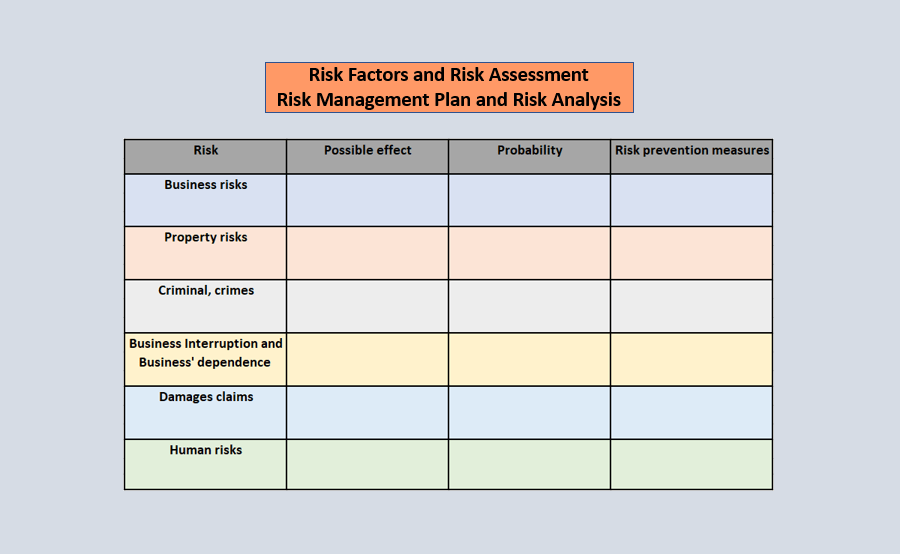
  • Make a risk survey for your business and create a risk analysis that will form the risk management plan.
  • Use the table "Risk Factors and Risk Assessment; Risk Management Plan and Risk Analysis" below
Risk Factors and Risk Assessment Risk Management and Risk Analysis. Types of financial risks, effect, probability, prevention measures

Risk factors and Risk survey

Complete a risk analysis for your business.

Insurances for business

  • Create a summary of the insurances your business may need. Carefully consider and evaluate company's insurance coverage needs based on potential risks
  • Use as a basis a risk management action plan and add the necessary insurance as a protecting measure

Insurance - Entrepreneur's Pension Insurance

Consider the importance of legislation, the significance of the rule of law to your business:

  • Which laws apply to your business?
  • Which laws are most important to your business?
  • The list of all most important laws and regulations governing the activities of different types of the organization in Finland you can find at the section "Finnish legislation for entrepreneurs" at our website.
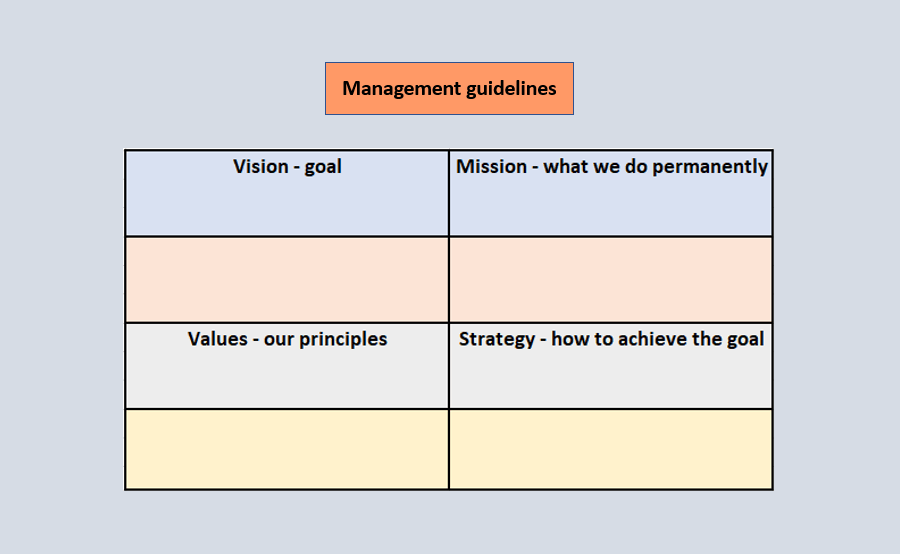
  • Define vision, mission and values of your organization
  • Determine your business strategy
  • Briefly describe what kind of manager you would like to be. Describe your management style.
  • Write above-mentioned issues concerning vision, mission, values and strategy to the following slide:
Management guidelines. Vision, mission, values and strategy

Management guidelines

Describe:

  • vision, mission, values of your organization and business strategy
  • what kind of manager you would like to be
  • At this stage, you can prepare a preliminary self-monitoring plan for your business, if it is required by the law.
  • Add a description of the permissions and licenses required for your company
  • Consider what kind of founding documents your business will need
  • More information about "Constituent documents" read at our website.

Write your own assessment of the future business and growth potential for yourself and your business.

  • Consider and assess your own entrepreneurial readiness.
  • Assess your personal qualities fairly and without fear.
  • Assess the significance of your qualifications and experience for the future business. What kind of education and experience do you have? Do you have entrepreneurial experience? What useful knowledge and skills do you have for business? What kind of things did you miss in your studying? What would you like to learn?
  • State the main reasons that encourage you to become an entrepreneur.
  • Develop a business idea and identify your niche.
  • Complete a marketing analysis and set a goal. What are your goals and how are you going to achieve them?
  • Develop a business plan
  • Identify resource needs and find real sources of funding.
  • How do you think, in what situations you will need an external help?
  • Consider briefly how do you see your potential company in the future in the changing Finnish society and global world?

  previous page   next page