
Principle of recognition of income and expenses
Finnish Accounting Act 1336/ 1997 requires recognition of income and expenses in the accounting periods to which they relate. The Income account (financial result account) records the income received during the financial year and expenses which have been used to generate this revenue, that is, short-term expenses and that part of long-term expenses for which the income was received during the reporting period.
When a company's result is calculated for each financial year by comparing the income for the financial year with the expenses incurred to obtain it, it is found that in some cases the accounts also contain items that do not belong to that financial year. The Purchase Expense Account is a typical example. Costs of goods purchased for sale are recorded on the debit side of this account. The financial year includes only the costs of acquiring the goods sold, which is transferred from the purchase account to the debit side of the financial result account (income account) because only these costs have generated the revenue during the financial year. However, if there are unsold goods left, i.e., there is a stock balance in the warehouse, then part of the costs should be attributed to the next financial period. These expenses indicate the cost of acquiring the remaining and unsold goods, that is, the value of the inventory in the warehouse. The acquisition cost of the remaining inventory is recorded on the credit side of the purchase account and carried forward to the next fiscal year by transferring it to the debit side of the balance sheet account. It should be noted that in practice, in addition to the purchase account, it is worth to use also two additional accounts: the inventory account and the inventory change account.
The procedure described above is called recognition of income and expenses. The recognition means distribution of income and expenses for those that will be recorded to the financial result account for the financial year and others which balances will be carried forward for next period.
The process of income and expense recognition can be shown according to the following examples.
EXAMPLE 1:
- 14.12. has been made an insurance payment for the period 1.12.- 31.5. in amount EUR 6 000.
- The financial statements will be made on 31 December.
- Thus, the amount of EUR 1 000 has to be recorded as an expense for the financial year in the financial result account and EUR 5 000 is transferred to the balance sheet.

EXAMPLE 2:
- 31.12. There are goods in the warehouse which worth is 7 000 euros. The accruals have been made in such a way that the acquisition cost of goods sold in the income account has been recorded at EUR 60 000, and the acquisition cost of the unsold goods has been transferred to the balance sheet account at EUR 7 000.
- The total cost for equipment acquiring of EUR 8 000 has been incurred during the period. The useful life of the equipment, for example, is ten years. One-tenth of the equipment costs have been entered in the income account, i.e., EUR 800 written off, and the rest in the amount of EUR 7 200 has been entered in the balance sheet account.
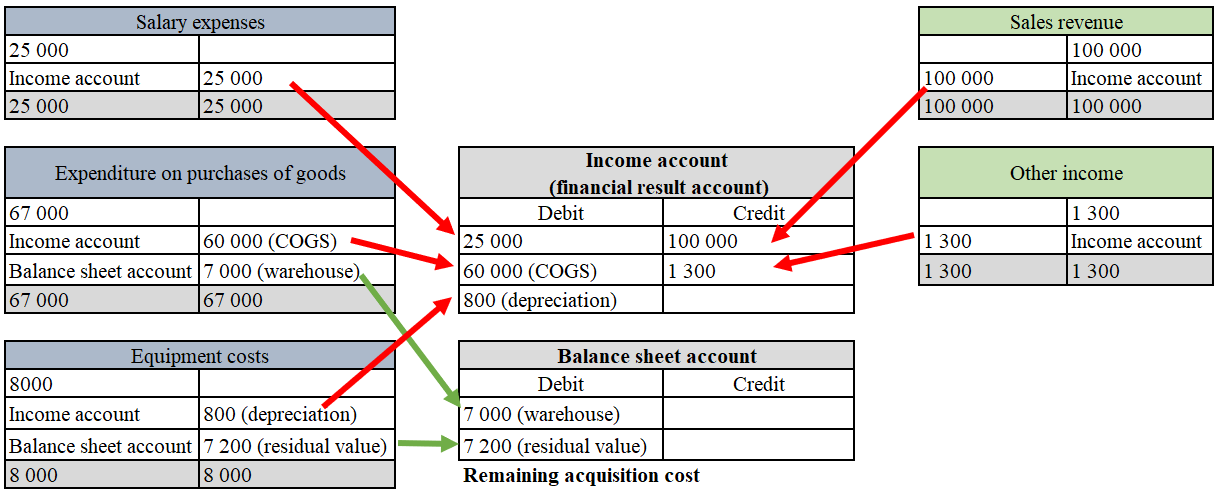
For the simplicity, it has been recorded only one amount and totals for each account. Cash and capital accounts, inventory account and depreciation expense account are not included in this example.