Customers: Relationships, Satisfaction and Target Groups

Customers are one of the key elements of any business. Even a good product or service cannot create a sustainable business without understanding who the customer is, what need they want to satisfy, how they make a purchasing decision and what influences their subsequent attitude towards the company.
Working with customers does not end after the first purchase. A company interacts with customers at different stages: from the emergence of a need and the search for a suitable offer to making a decision, using the product or service and providing feedback.
Therefore, when planning a business, it is important not only to identify target groups, but also to understand how customer relationships develop, how to assess customer satisfaction and how to divide customers into groups. This helps the company better understand its customers and make informed decisions about its offering, sales and work with customers.
Customer Relationships and the Customer Relationship Lifecycle
Sustainable customer relationships are built on more than just a sale. A company interacts with customers at different stages and receives information that helps it better understand their needs and improve its offering.
Customer feedback and experience with a product or service allow a company to assess how well its offering meets customer expectations and identify opportunities for improvement.
Customer Relationship Lifecycle
![Customer Relationship Lifecycle]()
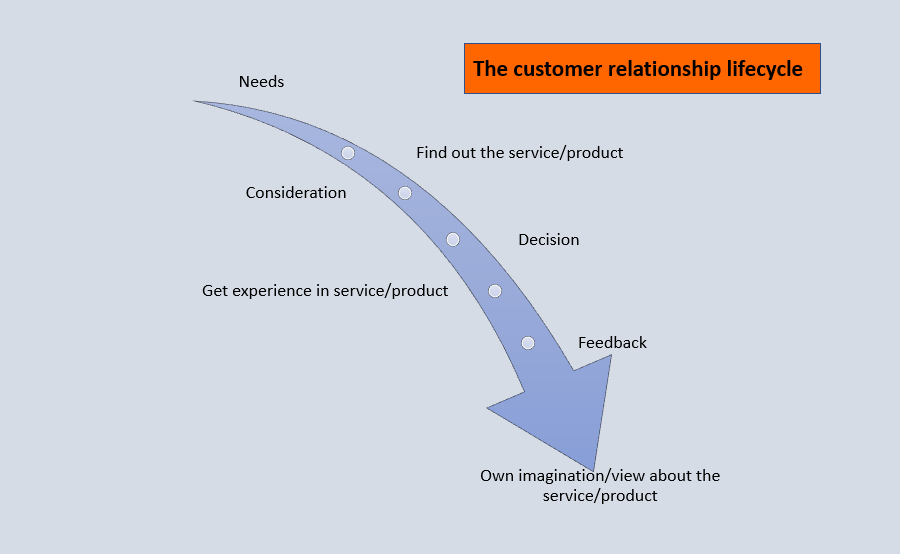
The customer relationship lifecycle shows the main stages of the customer journey — from the emergence of a need to forming an opinion about the product, service and company.
The main stages can be presented as follows:
- need — the customer has a need or problem that requires a solution;
- information search — the customer learns about available products or services;
- consideration — compares the available options;
- decision — decides whether to purchase a product or use a service;
- experience — evaluates the result and how well it meets expectations;
- feedback — leaves a review or tells the company about their experience;
- personal opinion — forms an opinion about the product, service and company.
Customer Satisfaction and Customer Base
To better understand customers and develop an offering in line with their needs, a company needs to collect and analyse information about them. This may include information from public sources, questionnaires and feedback forms, surveys, interviews, monitoring customer behaviour and other research methods.
This information helps the company understand what customers expect from a product or service, which characteristics are important to them and how well their experience meets their expectations.
Customer Satisfaction Levels
![Customer Satisfaction and Customer Base]()
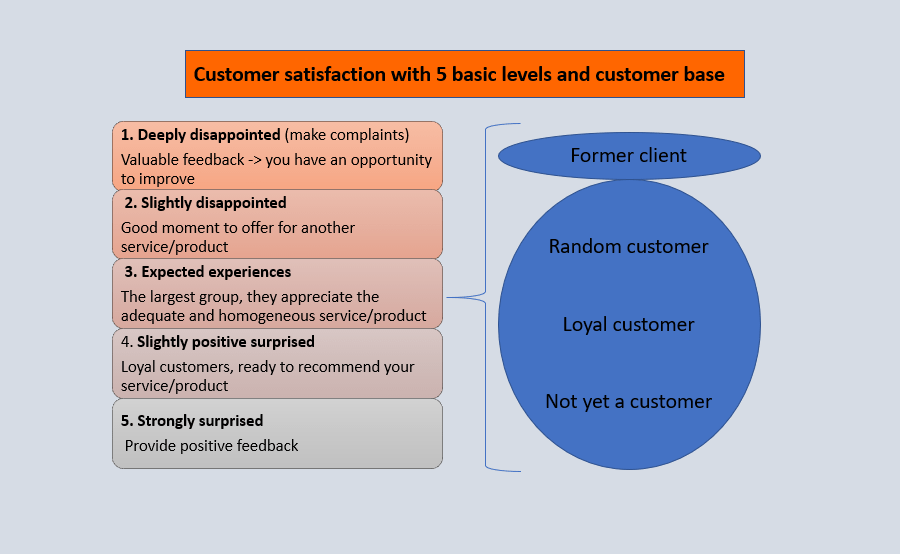
Customer satisfaction depends on how well the experience received matches their expectations. Within this model, five main levels can be identified:
- Deeply disappointed — the experience is significantly worse than the customer's expectations.
- Slightly disappointed — the experience is somewhat worse than the customer's expectations.
- Received the expected experience — the experience matches the customer's expectations.
- Slightly positively surprised — the experience is somewhat better than the customer's expectations.
- Strongly positively surprised — the experience is significantly better than the customer's expectations.
This classification helps the company look at its offering from the customer's perspective and identify changes that could increase customer satisfaction.
Customer Base
Customer base is the total group of customers and potential customers with whom the company interacts, has interacted or plans to interact.
The customer base can include different groups of customers and potential customers:
- potential customers ("not yet customers");
- occasional customers;
- loyal customers;
- former customers.
Different groups may require different ways of interacting with them. For example, a potential customer needs information about the product or service and help making a decision, while with existing customers the company can focus on repeat purchases and developing long-term relationships.
Customer Groups and Target Audience
Not all customers are the same — they differ in their needs, habits, location and ways of finding information.
Target customer group is a segment of an audience with similar characteristics and behaviour that the company targets with its product, marketing and sales.
Segmentation criteria depend on the type of business:
- B2C (individuals): age, place of residence, interests, purchase frequency and key needs.
- B2B (companies): industry, business size, geographical location and decision-making structure.
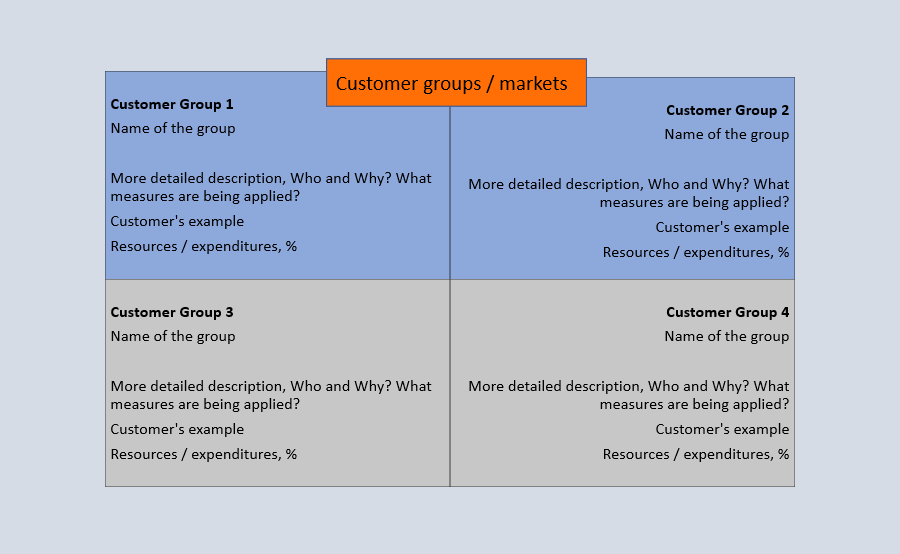
Identifying 3–5 priority groups helps adapt the offering, select appropriate marketing channels and allocate the budget effectively. By describing each group and assessing the resources required, the company can understand which customers to focus its sales and marketing efforts on.
![Customer Groups and Markets]()
For each group, it is useful to identify:
- who belongs to the group;
- what needs these customers have;
- why they may be interested in your offering;
- where potential customers are located;
- how they usually find products and services;
- what influences their purchasing decision;
- what resources and costs are associated with working with this group.
You can also give several examples of potential customers for each group. This helps make the description of the target audience more specific and better understand which groups are most important for the business.
Customers in the Business Plan: Target Group Analysis
When preparing the customer section of a business plan, answer the following questions, grouped into key stages of the analysis.
Block 1. Customers and Their Needs
1. Which target groups are priorities for your business?
Identify 3–5 main groups and briefly explain why these groups are particularly important to your business.
2. What need or problem does your offering solve for each group?
Describe the specific need, problem or task of each group and show how your product or service helps solve it.
3. What influences the purchasing decision of each target group?
Identify the main selection criteria: price, quality, convenience, location, company reputation, recommendations, speed of service or other factors.
Block 2. Finding and Attracting Customers
4. Where do customers usually find products and services?
Identify the main sources of information: search engines, social media, recommendations, advertising, specialised websites, stores, events or other channels.
5. How do you plan to attract customers?
Identify the specific marketing channels and methods you plan to use and explain why they are suitable for the selected target groups.
6. What may lead to a repeat purchase?
Describe the factors that may encourage customers to return: product or service quality, satisfaction, service, convenience, loyalty programmes, new offers or a recurring need.
Block 3. Potential Market and Sales by Target Group
7. What is the size of the potential market for the selected target groups?
Provide available data on the number of potential customers in the selected target groups and indicate the source or method used to estimate it.
8. How many potential customers from the selected target groups do you plan to attract?
Indicate the projected number of potential customers at the initial stage and in subsequent periods, if such estimates have already been made. If possible, provide separate figures for the main target groups.
9. How many of the potential customers you attract may become buyers?
Estimate what proportion of the potential customers you attract may proceed to make a purchase and determine the expected number of buyers.
Block 4. Specifics of B2B Customer Analysis
10. Who makes the purchasing decision on the customer company's side?
Identify the person or people involved in the decision-making process, their role in the company and their influence on the choice of supplier or product.
11. What factors influence a company's decision when choosing a supplier?
Identify the main selection criteria: price, quality, contract terms, delivery times, supplier reputation, technical requirements or other factors.
12. How will the B2B sales process be organised?
Describe the main stages of interaction with the customer company: establishing contact, negotiations, preparing an offer, making a decision and concluding a deal.
This analysis helps connect an understanding of customers with the company's practical decisions: what to offer, who to offer it to, how to find customers and how to build relationships with them.
A deep understanding of the target audience is the foundation for building a viable business. Dividing customers and potential customers into groups helps determine whom to target with the offering, which channels to use for attracting customers and what resources are needed to work with different groups.
In a business plan, customer analysis should show who the product or service is intended for, how large the potential market is, how the company plans to find customers and how many sales it expects to generate. This information helps support the chosen business model and financial calculations.